
News
From the Depths to the Surface, a Day Exploring the Future of Ocean Science
Tuesday, 21 July 2026
SEA Main Campus, Falmouth, Massachusetts
WHOI Quissett Campus
Woods Hole, Massachusetts
This morning we had the privilege to be lectured by PhD student Avery Fulford. She taught us about deep sea hydrothermal vents. This was -in my opinion- the best lecture yet. There are multiple types of hydrothermal vents, separated based on what they expel. Fulford mainly focuses on brine-dominated hydrothermal vents which is theorised to be the origin of life on Earth. This was incredibly interesting to me because she talked about how other planets and moons have been found to have oceans as well, and also contain hydrothermal vents!! This makes it entirely possible that the microbial organisms which evolved because of these brine-dominated hydrothermal vents to also have evolved or possibly evolve on other planets! It’s crazy to think that there is such a sure possibility of life forming on other planets and it really brings into perspective the possibility or rather the probability of extraterrestrial life.
After the lecture, me and my group worked on our research project. We are focusing on plankton and how ocean acidification, salinity, and human interaction are affecting plankton populations on our shores. We recently did a few plankton tows and collected large amounts of samples of plankton, which we studied in the lab under microscopes. We counted the number of different taxa (species) we found in our samples and compared them between our different sites. It was really interesting to see that there was a large difference in taxa when comparing the two sites. We haven’t done the analysis for our data yet, but we are highly suspicious the differences in taxa populations is mostly likely due to location rather than pH and the other factors we are measuring for.
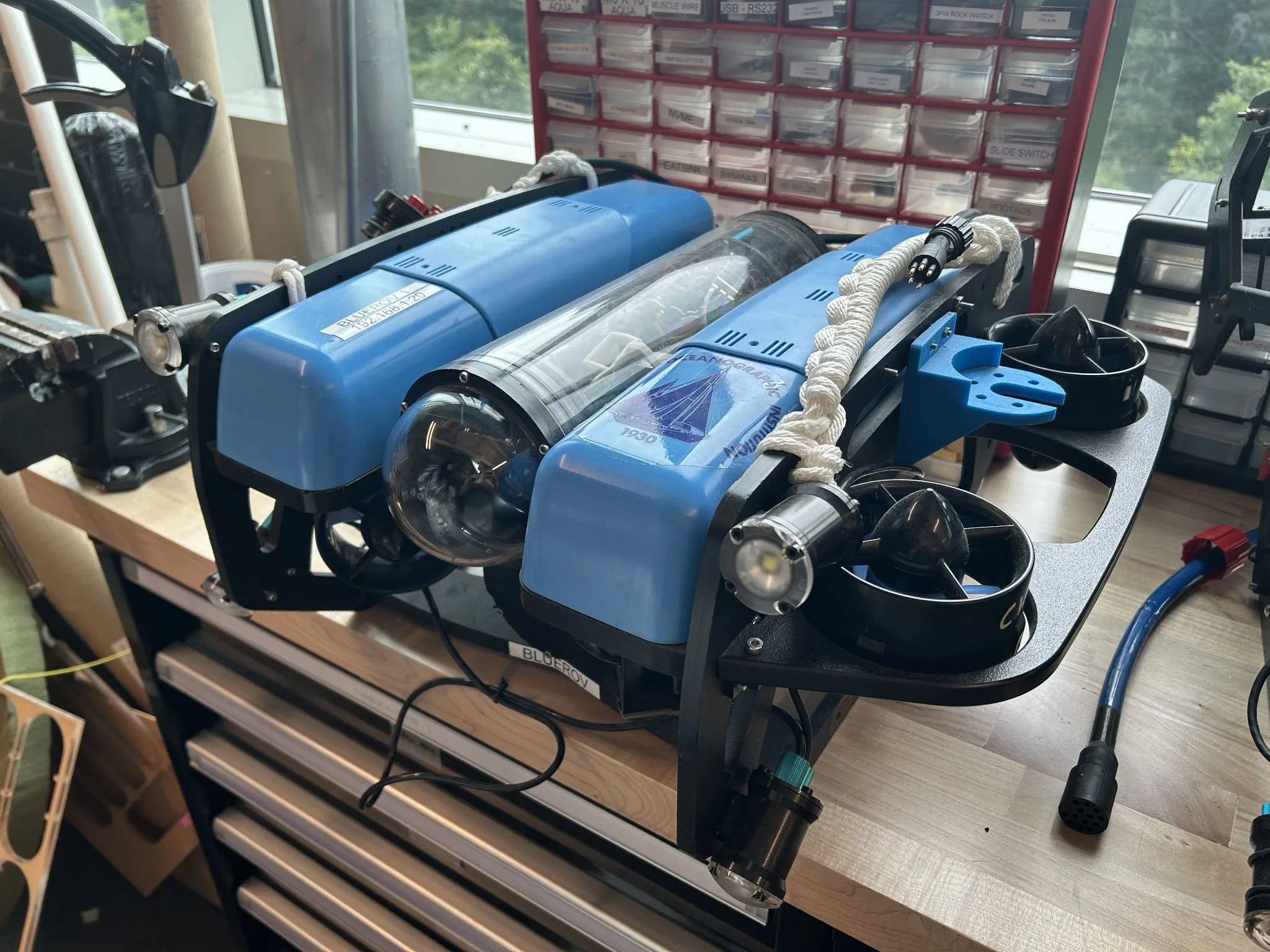
In the afternoon, we went to the Quissett Campus of WHOI (Woods Hole Oceanographic Institution), and toured around the different labs and organizations housed inside the institution. First we visited a technology organization called DeepTech, which builds machines and robots to perform sea exploration. In the short history of sea exploration, there have been mostly large, clunky, inefficient models of robots and drones used. However recently, at WHOI, new Medium-Class Remotely Operated Vehicles (mROVs) are being engineered and fashioned into prototypes. These robots are built to be sleeker and more adaptive for the harsh climates of the deep sea. Different types of robots are also being developed to explore and record complex underwater ecosystems like coral reefs. These robots have high-tech cameras and developed acoustic localization systems to track the sea floor and the ecosystems there
We visited another lab, extremely different from the robotics lab, in the WHOI center which was a necropsy lab. (This difference in labs really shows not only the diverse range of fields that WHOI houses, but also the incredible range within ocean sciences as a whole). The necropsy lab collected dead animals who died of natural causes, dissected them and studied their bodies to figure out why they died and how they could protect the rest of the species from dying from the same cause.
We also toured labs which studied antioxidants in corals and different marine ecosystems, and also developed ways to give corals an edge for growth. Right now they are developing a way to infuse Manganese into platforms which coral polyps attach to and grow abundantly on.
I personally found the fact that Manganese dramatically helped the growth of coral polyps fascinating! Now I’m wondering if there is a way to infuse Manganese into some sort of material we could “spray” on dying coral reefs or even dead ones to encourage regrowth. That would be absolutely amazing and it is incredibly important right now due to the extreme coral bleaching taking place these past few years.
Aryana, SEA Pre-College Oceanography