
News
Learning More About Whale Entanglement in Provincetown
Sunday June 7, 2026
Woods Hole, MA
1030 PM
The voyage aboard the Corwith Cramer finished this morning and the student crew is now back on campus to spend the week processing their experience and putting together their special issue of SEA Writer magazine. The second leg of their voyage, after they left the anchorage off Nantucket, is told in the following student interview with fellow-student Camryn Hartigan, conducted in the lab of the Corwith Cramer.
Hello, who am I here with?
My name is Sarah Wallen. I’m from Rochester, New York, and I go to Syracuse University. I’m studying Forensic Science, Sociology, and Law Policy and Society, and I’m going into my senior year.
So yesterday we had our very first trip on shore. We are on the Cramer right now and yesterday was the first time that we got off since we first got on in Woods Hole on the 29th.
I was really glad that we were going to get off the boat. Being on the boat, I’ve never been on a boat like this before, and I think it was just going back to land: like my body was like, ‘Okay we’re safe again.’ It was really nice because we didn’t get to get off in Nantucket because the weather was really bad, and we wouldn’t have been able to make it to shore safely. But yesterday we got on a little tiny boat, six of us, and we went back and forth and did shifts. The crew did that. That was really, really awesome and helpful.
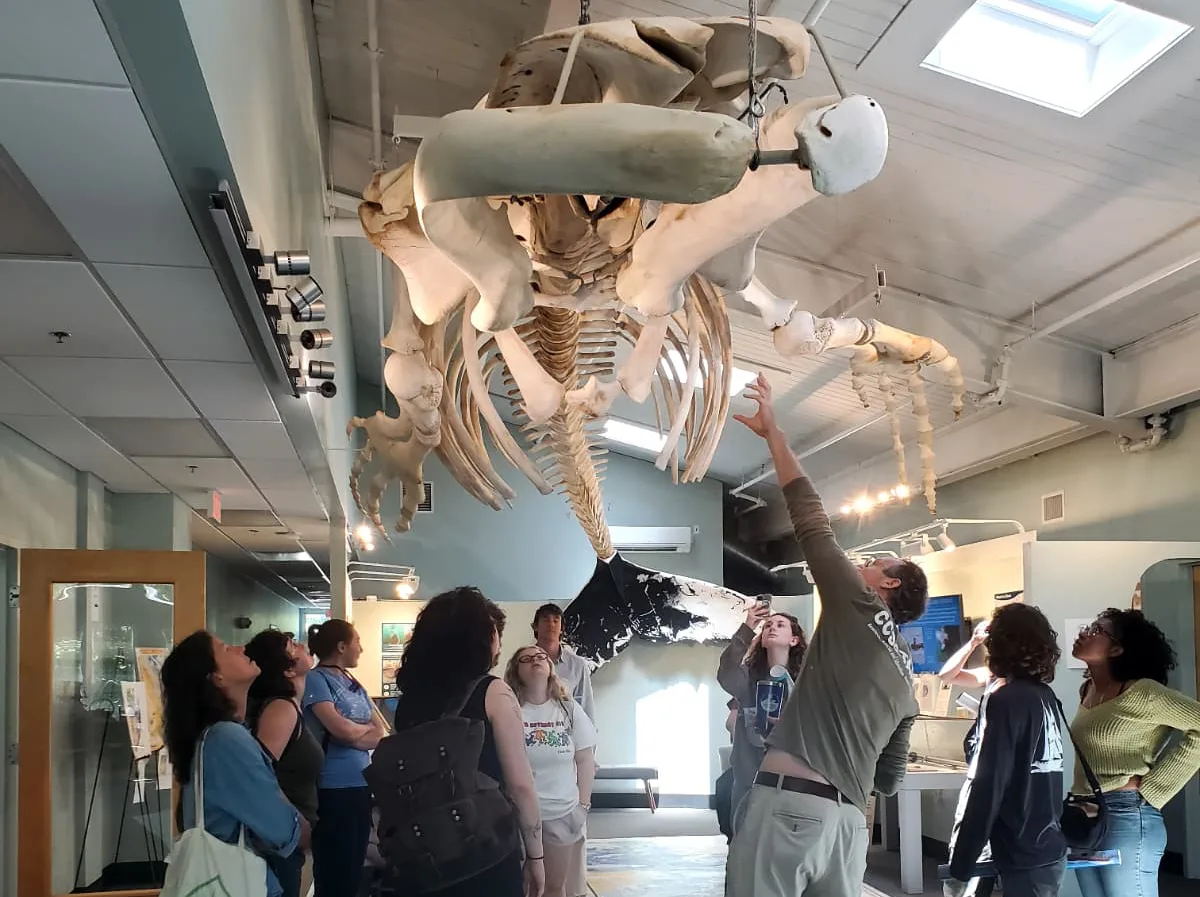
And then we walked around to a few shops at first and then we had a meeting with the Center for Coastal Studies in Provincetown.
Provincetown is actually where the pilgrims first landed and then they were like, ‘Nah we don’t like it here,’ so then they went to Plymouth. But they went there first and [now] there’s a giant building there. And it’s literally just for the pilgrims.
After that we went to the Center for Coastal Studies. We talked to [Marine Education Director, Jesse Mechling]. He was cool. Well first we actually bought everything from the gift shop, like actually we bought so much of their stuff! I bought a bunch of stickers and stuff, some people got shirts, people got hats, super cool.
But basically we talked about the different identification systems, how they identify different whales based on the patterns on their tails and the different names. And then we talked about entanglement, which actually is very relevant to what I’m writing my article about for our final project. I’m writing about death rates in marine mammals and turtles based on the amounts of plastic and kinds of plastic they have in their stomachs, because when they find them dead they will study them.
Necropsy. We talked about it yesterday, and I was like, oh I know what that is. He showed us a bunch of different pictures of whales and he showed us the story of this one whale. I can’t remember her name, but it was like Spinner…
“Spinnaker.”
“Spinnaker,” yes! “Spinnaker.” And she had a very empowering but sad story where she was entangled, and they tried to cut it out in the very beginning and they were like, yes we did it. And then they saw her again and then cut her out in another place, because these freaking, dude, these freaking lobster traps are ruining everything for us and these whales. But when they cut her off again they noticed something else on her, and they couldn’t find her and then I think a few weeks later she was unfortunately found dead, washed up. And then they saw that the line actually was in her mouth and went in and cut into her bone after years and years and years, which is really crazy.
Yeah, I agree, that story was so impactful, and I just could not stop thinking about it after we left. On a more exciting note, I’ve heard that you have some exciting summer plans for after this program.
I ended up securing this summer an internship on the Hill with Tom Suozzi. He is New York district three representative congressman, and he’s from the Long Island area and I’m really excited to work on the Hill officially, and the DC environment is very interesting. And I’m really excited to talk to the environmental sector of his staff and go to those types of meetings, because I’ll have a lot of flexibility to be able to go to meetings along with taking phone calls and giving tours, but they’re very open with letting me go and witness meetings and I’ll get some real insight on the actual environmental policy that’s happening right now.
Hopefully in the future the plan is to apply to law school in the fall and study environmental law.
Awesome, well thank you so much.
Yeah, thanks guys. Save the whales.
