
Programs Blog
Thinking Back to That First week in St. Croix!
Tuesday, 24 Feb. 2026
Partly cloudy, light wind, before 2100 watch
Anchored 75m off shore in Frederiksted, St. Croix
Please excuse the tardiness of this entry, we have been very busy this last week and it was hard for me to work on a computer when we were underway…
Hello from St. Croix! This week has been so amazing and full of laughter, adventure and fun! We started off boarding the absolutely gorgeous Corwith Cramer, and prepping for the rest of our trip by meeting our crew, having orientation, and getting to see and set up our bunks. My bunk is in the aft, port side corner of the ship, (an area that used to be quite stuffy before active ventilation was added) and although I a very small amount of storage area, I somehow made it work! After meeting everyone and having dinner, we headed to bed, so that we could get ready for the real fun- learning about St. Croix, starting research, and becoming real sailors.
For our first night, we did not have to do a night watch, but we did still have to get up bright and early for our first breakfast and field trip. We went to The Nature Conservancy in Christiansted, St. Croix, where we got to meet Mr. Kemit the aquatic specialist and Amanda a long-term intern. There we got to see coral nurseries that are being used to research and increase the speed of coral growth via methods of fragmentation and sexual reproduction, and some of the other cool methods and tools they are using to better the environment (planting mangroves, etc.) In addition to this, we also learned more about some of St. Croix history, such as how back in colonial times, corals were cut out as blocks and also used as part of the lime in mortar to create buildings. This was due to a belief that they were a renewable resource, and that they would strengthen the lime. Fun fact: you can still see them in those structures today. After our tour, everyone got to do a snorkel training session, while I sat at the beach playing coconut fetch with NOOCH, Ryan’s dog. This was because Heather and Craig wanted me to take it easy before we figured out the cause of inner ear issues (which we later learned were temporary). For the remainder of the day we continued with lunch and some more orientation/training to get further settled with ship life.
For our second night, we began our boat watches! It was honestly kind of scary to be woken up in the middle of the night (for reference my first shift was 0200-0300) and told that it was our turn to make sure the boat and everyone were safe. It was supervised of course, but still a little nerve wracking! After completing it, I realized that it wasn’t half bad, and that getting up meant that I could see things that I’ve never seen before like shooting stars, the occasional bioluminescence, and rolling waves at night. That morning we again got up bright and early for our field trip, and this time it was to the East End Marine Park (EEMP). This was a gorgeous marine and terrestrial protected area that absolutely blew my mind with its beauty. Craig misled us a bit when he said he thought it would be a relatively flat hike, but when Professor Olasee Davis led us away from our rendezvous point at the beach, the reality was that it was a 45 minutes-long hike to the top of the highest part of the eastern end of the island (and most eastern point of the United states. It was an exhausting trek, but the views and what we learned from Professor Davis were definitely worth it. For the second half of our tour we visited the office portion of the EEMP. It was pretty cool, with a heavy emphasis on policy, but just enough biology to keep me interested.
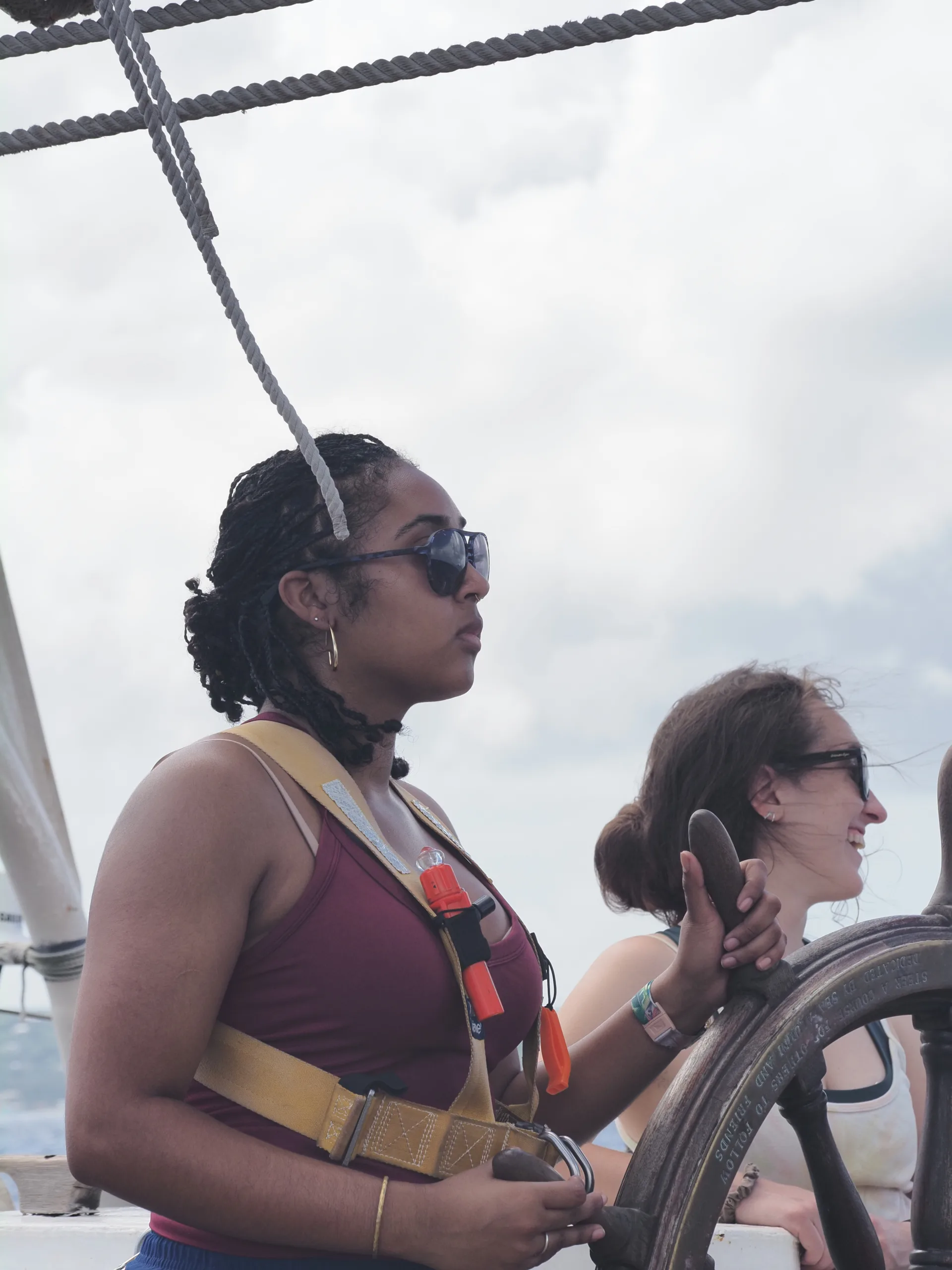
The next day was our first day underway! This meant that we spent our morning setting up the ship to travel roughly 4 hours to Frederiksted, and honestly I think everything went pretty well! The day before we did some training and now we got to put it to use! I am in the group C-watch, and my instructors are Obie and Kayla. We had first watch underway, so I got to be fully on deck for a large portion of our travels. This meant I got to haul lines, actually steer at the helm, and move around like a whole bunch, doing tasks! You don’t understand how much goes into sailing a ship until you’re hands-on like this. It was so exhilarating and fun, and honestly I truly feel more like a sailor because of it. And mom because I know you’re probably wondering, yes the scopolamine patches did work, but not completely, as some of the large swells did make me nauseated. Once we made it to Frederiksted, I basically ate and went to bed, just because of how exhausted I was.
The next morning was our first field trip in Frederiksted. We visited the Feather Leaf Inn, which is run by Corina Marks. This inn is not like ordinary inns, outside of its regular operations, it also functions as a conservation and restoration site that collaborates with some of the other organization we previously visited (TNC and EEMP). The inn focuses on various forms of coral and environmental restoration, like working with Elkhorn corals and by planting mangroves. In addition to this, both the inn and Ms. Corina, also prioritize communication and education of the surrounding community, through discussions with town advisors and education opportunities with the schools. It was really cool to learn about her and the inn’s various conservation and environmental communication techniques and I hope to utilize them in my own work in the future.
On the last day of the week, unlike the other students, I did not attend all of the morning tour for our next field trip while I had my ears checked. Instead, I caught the tail end and went on to enjoy our first period of free time in St. Croix. I explored the city, ate good food, and hung out at the beach with a few friends, and honestly it was one of my favorite days so far. The next two days of our trip, is when our research truly began. We headed to Cane Bay via taxi, and this is where we began practicing our snorkel data collection techniques, and later put them to work. My main role during these days, was to help dive down to set up our transect line, take photos for later analysis, and set up and analyze the rugosity chain. This was not an easy task because the conditions that day were moderately rough, with high turbidity, swells, and currents. This meant that we did end up needing help from the pro-crew, but I am proud to say that I was still able to dive down the full 20ft, and that I was able to collect quite a bit of the data for my team.
Overall, this week was so amazing and although it was long and jam-packed with adventures, I can confidently say that I am not tired of it all yet. I am so excited to see what these next weeks have in store, and I am even more excited to actually begin our sailing adventures. I will do my best to keep y’all updated with a blog post at least once every one to two weeks, but no promises that they’re this long. I can’t wait to see everyone again soon!
Sincerely,
Future marine biologist and zoologist, Bella Braxton, C Watch, University of North Carolina, Wilmington
Shout outs: Mom and Dad I miss and love y’all!! Billy I hope everything is going well with the girl, and love you! To my very best friend Nadia, I miss you so so much and I can’t wait to see you during summer! To my friends back at UNCW, I miss you guys and I hope you know that were going out when I get back! To my entire family I’m sending my love. To Barkley and Neptune, how are my good boys, and you better behave yourselves while I’m gone. Hi, Captain Rick!! And finally, to everyone….Go watch SURVIVOR UNCW Season 4 on YouTube!!! I can’t wait so see you all again! Love y’all!
Recent Posts from the Ships
- Ocean Classroom 2024-A collaborative high school program with Proctor Academy
- Collaborations and Long-term Commitments: SEA’s Caribbean Reef Program Sets a Course for Coastal Programs that Compliment Shipboard Experiences.
- Sea Education Association students prepare for life underway using state of the art nautical simulation from Wartsila Corporation.
- SEA Writer 2022, Magazines From the Summer SEA Quest Students
- Technology@SEA: Upgrades Allow Insight into Ocean Depths
Programs
- Gap Year
- Ocean Exploration
- High School
- Science at SEA
- SEA Expedition
- SEAScape
- Pre-College
- Proctor Ocean Classroom
- Protecting the Phoenix Islands
- SPICE
- Stanford@SEA
- Undergraduate
- Climate and Society
- Climate Change and Coastal Resilience
- Coral Reef Conservation
- Marine Biodiversity and Conservation
- MBL
- Ocean Exploration: Plastics
- Ocean Policy: Marine Protected Areas
- Oceans and Climate
- Pacific Reef Expedition
- Plastics and Biodiversity in the Sargasso Sea
- The Global Ocean: Hawai'i
- The Global Ocean: New Zealand
- The History of Whaling & Whale Conservation