
Programs Blog
Reducing Global Climate Change Threats in Dominica
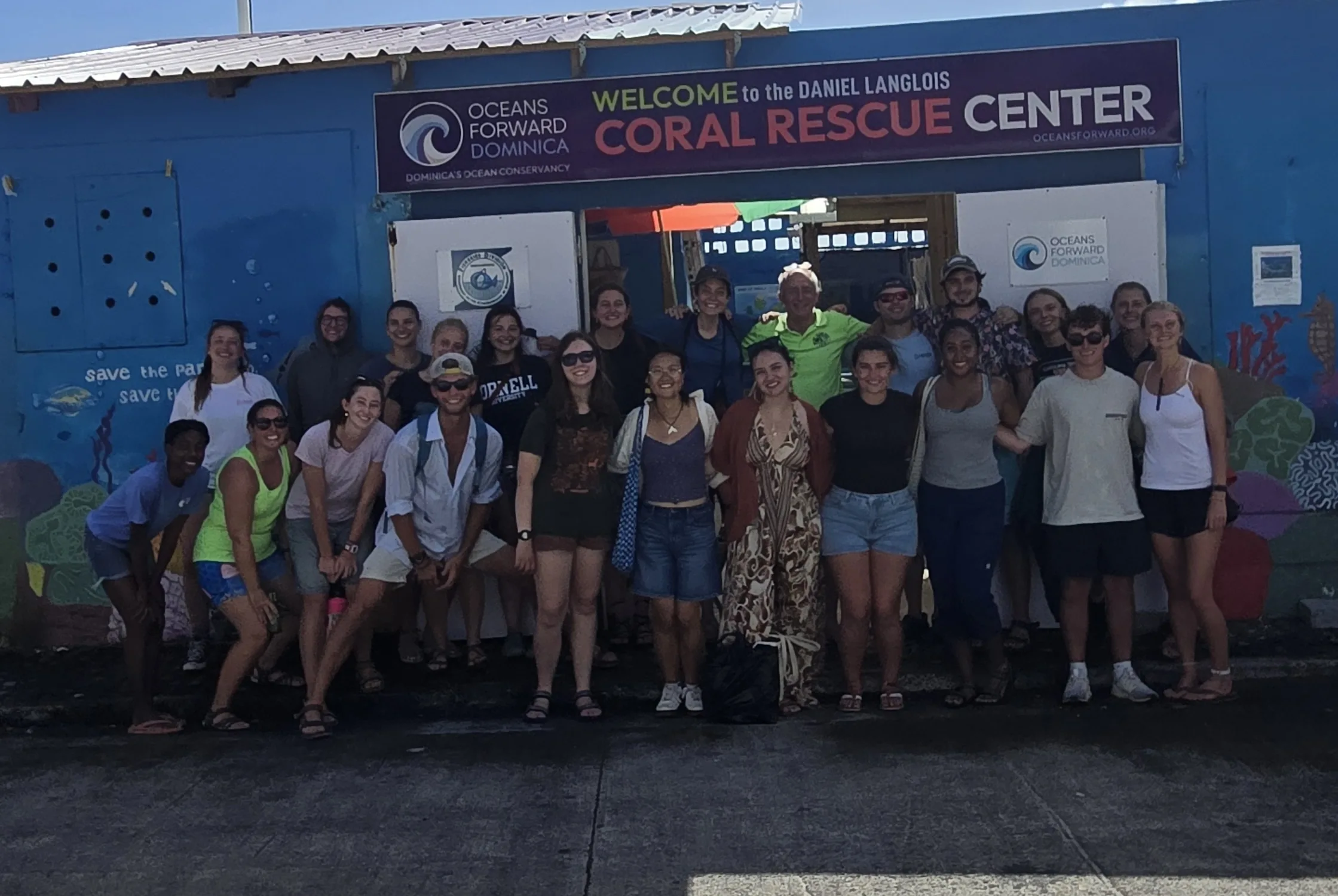
During our time in Dominica, it became clear that coral reefs around the island are facing mounting pressures from both global climate change and local environmental stressors. Rising ocean temperatures, coral disease, sediment runoff, and coastal development all contribute to reef decline across the Caribbean, and Dominica is no exception. Yet what was striking about the island was not only the scale of the challenge but also the determination of local scientists, divers, and communities who are working to protect what remains of these ecosystems.
While in Dominica, we traveled to the coastal village of Soufriere to visit a coral restoration site operated by Oceans Forward. The project operates alongside a dive shop run by Simon Walsh. He and his colleague Joe are two divers whose dedication has earned them the nickname “the Coral Daddies” among residents. What began as a small grassroots effort has grown into an ambitious coral conservation initiative. Beside the shop, nineteen carefully maintained tanks hold fragments of coral colonies that have been rescued from diseased or declining reefs. These tanks serve as living archives of reef biodiversity, preserving genetic material that might otherwise be lost from the surrounding marine environment.
Simon and Joe partnered with Oceans Forward four years ago with a guiding philosophy they describe as restoration over recreation. Unlike many dive operations that prioritize tourism, their dives focus on reef monitoring and intervention. When they encounter diseased coral colonies underwater, they treat them directly during the dive using methods developed by coral disease researchers. This approach transforms each dive into a form of ecological stewardship rather than a purely recreational activity.
The restoration work at Oceans Forward centers on several techniques designed to maintain coral populations and increase reef resilience. One of the most important is biobanking. In this process, fragments from healthy coral colonies are collected and maintained in controlled tanks to preserve their genetic material even if wild populations decline. At the facility, biobanks currently contain representatives from more than two dozen coral species native to Dominican reefs. These collections function as a safeguard for the future, allowing restoration practitioners to reintroduce coral genotypes back onto degraded reefs when conditions allow.
Another key method is coral fragmentation, a technique that accelerates coral growth by dividing colonies into smaller pieces that can regenerate rapidly. Each fragment continues to grow into an independent colony while retaining the genetic identity of the original coral. Over time, these fragments can be transplanted back onto reef structures where they expand and form new coral cover. This process is especially important for slow growing species that struggle to recover naturally after disturbances such as disease outbreaks or bleaching events.
The team is also developing coral spawning systems to support sexual reproduction in captivity. By carefully manipulating light cycles and water conditions, they hope to encourage corals in the tanks to release eggs and sperm, allowing fertilization to occur under controlled conditions. This approach has the potential to generate genetically diverse coral larvae that can later settle onto restoration sites. Brain corals appear particularly responsive to this form of reproduction, which offers promise for rebuilding complex reef structures that support fish and invertebrate communities.
Although Oceans Forward is an inspiring example of local conservation, the broader ecological context of Dominica also shapes the future of its reefs. One important dimension is the Kalinago Territory on the island’s eastern coast. The Kalinago people are the Indigenous inhabitants of Dominica and maintain strong cultural and ecological ties to the land and sea. Their territory spans a large stretch of coastline, where traditional knowledge and community stewardship continue to shape how natural resources are used. The Kalinago have historically relied on coastal ecosystems for fishing and transportation, and their relationship with the ocean reflects a long standing understanding of environmental balance.
The presence of the Kalinago Territory highlights the importance of integrating Indigenous perspectives into coral reef conservation. Local ecological knowledge can provide insight into historical reef conditions that scientific monitoring sometimes cannot fully capture alone. In many cases, community-led stewardship practices help reduce pressures such as overfishing or habitat degradation. The protection of coral reefs around Dominica therefore depends not only on scientific restoration techniques but also on collaboration with communities that have lived alongside these ecosystems for generations.
What surprised us most during this visit was the scale of commitment that a small group of individuals could generate. Oceans Forward operates with limited resources, yet the passion and creativity of its founders have created a meaningful conservation effort that directly supports reef recovery. Seeing coral fragments growing in tanks, each representing the possibility of future reef regeneration, made us hopeful that the field work we are doing with corals is making a real impact.
Dominica’s reefs remain vulnerable to warming oceans and disease outbreaks that are intensifying across the Caribbean. But there is hope! Organizations like Oceans Forward demonstrate how community engagement can create pathways toward resilience. Protecting coral reefs will ultimately require global reductions in greenhouse gas emissions, but the work happening in places like Soufriere shows that local restoration efforts can play a critical role in sustaining reef ecosystems while the world works toward broader climate solutions.
Marguerite Brody, B-Watch, Trinity College; Andrew Berwanger, A-Watch, UNH
Recent Posts from the Ships
- Ocean Classroom 2024-A collaborative high school program with Proctor Academy
- Collaborations and Long-term Commitments: SEA’s Caribbean Reef Program Sets a Course for Coastal Programs that Compliment Shipboard Experiences.
- Sea Education Association students prepare for life underway using state of the art nautical simulation from Wartsila Corporation.
- SEA Writer 2022, Magazines From the Summer SEA Quest Students
- Technology@SEA: Upgrades Allow Insight into Ocean Depths
Programs
- Gap Year
- Ocean Exploration
- High School
- Science at SEA
- SEA Expedition
- SEAScape
- Pre-College
- Proctor Ocean Classroom
- Protecting the Phoenix Islands
- SPICE
- Stanford@SEA
- Undergraduate
- Climate and Society
- Climate Change and Coastal Resilience
- Coral Reef Conservation
- Marine Biodiversity and Conservation
- MBL
- Ocean Exploration: Plastics
- Ocean Policy: Marine Protected Areas
- Oceans and Climate
- Pacific Reef Expedition
- Plastics and Biodiversity in the Sargasso Sea
- The Global Ocean: Hawai'i
- The Global Ocean: New Zealand
- The History of Whaling & Whale Conservation