
Programs Blog
The Gift of Here and Now: Frenzies, Drumming, and Fish That Fly
Monday, 27 April, 2026.
Noon Position: (Lat and Long): 32 degrees 22.7’ N, 064 degrees 40.8’ W
Log (nm): 1678 nm
Weather / Wind / Sail Plan (from 1300 Watch Change): Wind SExE F4, clear skies, alongside at Pennos Wharf
Description of location: St. George’s, Bermuda
Hello world!
I’m Sophie, the Program Assistant and Medical Officer for this program. My role on board involves wearing a lot of different hats. In addition to taking care of everybody’s medical needs, I am an educator, community builder, deckhand, morale officer, galley dish supporter, musician, celestial navigator, and overseer of the blog. A few students believe that I am also the Kraken. Sometimes I am an “other,” keeping to a daytime schedule, and sometimes I stand watch with the students during odd hours of the night. It all depends on the needs of my shipmates and Cramer herself.
I’m excited to be writing the blog on such an eventful day. Not only is it my mom’s birthday (happy birthday, Mom!), but after 22 days at sea, today we sail into Bermuda, our “layover” on the way from St. Croix to Woods Hole. This is my sixth voyage with SEA (I was previously a student and then a deckhand), but this is the longest continuous time I’ve been out at sea.
It is amazing how quickly time goes by while we are immersed in our microcosm of community, sailing, and science underway. We are granted such a unique gift in today’s world to be present, completely absorbed by what is happening here and now. The immediate needs of the ship, our shipmates, and ourselves supersede all else. And it turns out there is a lot happening here and now, when we remove the impending doom and distractions from our phones, emails, and social media, and take the time to notice. I have decided to bring you along on three of my favorite ways to be present on board: through celestial navigation, music making, and moments of serendipity.
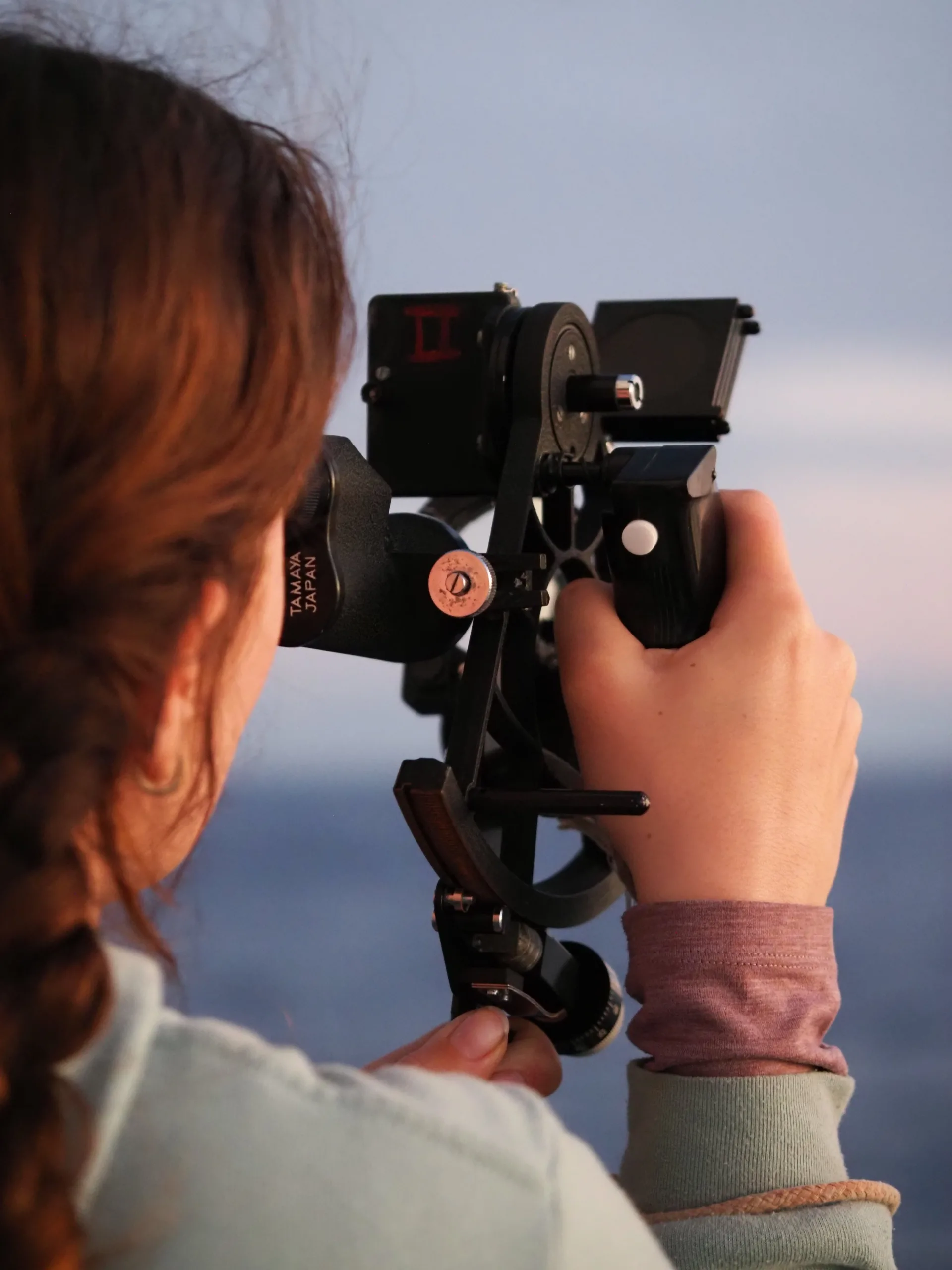
Zara wrote about celestial navigation and star frenzies in her blog, so I recommend you start there for more context. The big picture of cel nav is that while out at sea, without coastal landmarks like lighthouses, coastlines, and buoys, we can rely on celestial objects like the sun, moon, planets, and stars, to determine our location, no GPS required. These objects belong to an imaginary “celestial sphere,” and we use angle of arc from the object to our horizon, a “mathematic sleight of hand,” as deckhand Olivia calls it, to measure distance. With just angles and time, along with slow math from special books (the nautical almanac and pub. 229, or a much faster computer program), we can fix our position. This might sound boring and unnecessary (why not just use the GPS?), so let me paint a scene, and maybe you too can appreciate why star frenzies are so much fun.
The sun just went down, painting the western sky in a glow of orange light and quickly dimming the east into an inky blue. The sky is clear, boding well. Aboard Cramer, the second seating of dinner is wrapping up, and the eager navigators rush up through the chart house, carefully passing wooden sextant boxes up on deck, setting them down gently on the deck boxes. These instruments will be the key to our success. “There!” Sam points out to us, the gaggle of star shooters, “Venus is out, under the moon!” We squint, following his finger, and spot the white dot glowing brighter by the second, low in the sky. “Got it,” I shout back, quickly grabbing my sextant from its box and sharpening my focus of the horizon through the eyepiece. I have no index error—the horizon is a flat line at 0.0 minutes of arc. I angle my sextant where I see Venus and view it through my eyepiece on my first try, but that is the easy part. Now comes the trickier maneuver, bringing it down to the horizon. I grip the pinchers of the sextant’s index arm and slowly, carefully lower it down to the horizon. “Stay with me, Venus.” Beside me, Jakob, Natalie, Zara, Keya, and Etta are doing the same. When I get it close, I shift my left fingers from their grip on the index arm to the smaller micrometer drum, perfecting my placement of Venus on the horizon. My fingers have done this enough times that I don’t have to shift my gaze, keeping it locked on Venus instead. Things are looking pretty good as I rock my right hand from left to right, following the arc of the planet to be sure I have the lowest possible placement of Venus. Precision is the name of the game tonight.
I am not the only one getting close. Zara shouts, “Zara stand by on Venus!” and Simon answers “Standing by!” from somewhere behind us. Simon is our “paper boy” tonight, recording everyone’s exact times and measurements for us to input later. I add to the chaos, shouting “Sophie stand by on Venus!” as Zara yells “Mark!” “Mark,” responds Simon, jotting down Zara’s time and then responding, “Standing by, Sophie!” to me. Just as I give Simon my time with another emphatic “Mark!” and share with him my degrees of arc, Sam is pointing out that Arcturus, Sirius, and Dubhe are now all visible and great options for us to shoot. It is all a chaotic rush, a frenzy, as it is aptly named, to shoot as many stars as possible before night truly befalls us and the horizon becomes indistinguishable through the sextant, no more than an obscure blur of dark ocean blue against deep navy sky. This liminal time between civil and nautical twilight is one where every second counts. When our eyes inevitably begin to struggle to make out much in the darkness, we finally pack away our sextants and punch in our results. It is a fun game to see who got the best sights and calculate our position. We’ve been getting very good, usually a collective mile off from the GPS (which is excellent for navigational purposes when sailing the open ocean).
Star frenzies are chaotic, and like Sam spoke to in his blog, they are a kind of ceremony. Music jams on the house top are usually less chaotic, but they are also a kind of ceremony. I play traditional Irish music, primarily the Irish flute, which is wooden and keyless, and the Bodhrán, a round drum played with a wooden tipper. Music at sea is such a treat. For safety reasons, we don’t listen to recorded music on headphones or even on speakers, with the exception of field day. But with permission from the mate on deck, we can create our own music.
Yesterday, for example, I grabbed my instrument cases from where I stow them in my bunk and brought them up on deck and onto the house top (the “roof” of the chart house), where I heard Annie and Zara tuning their fiddles. As Lyra said in her blog, “we gotta get to a higher place.” It was a lovely afternoon, a “Sunday at sea” with no class, and the low sun and light breeze made ideal conditions for sailing and jamming alike. Off-watch students and professional crew were gathered on the quarter deck, reading books and working on creative projects. I accompanied the fiddles with punchy percussion on reels and marches and with melodic flute on polkas, jigs, and slides. Music at sea makes our days feel lively, filling our hearts in a way we cannot quite appreciate the same way on land. It is just as enjoyable to see my shipmates tapping along (or lilting, in Simon’s case), as it is fun to play.
You cannot predict moments of serendipity at sea, of course, but you can pretty much guarantee them. A few days ago, I was standing watch with B watch during a gale when a flying fish leapt out of the water and landed on our deck. I’ve seen so many flying fish from afar before. They always look to me like the ocean is spitting out gliding silvery leaves. They never seem particularly graceful as they splash back into the water. Truth be told, it’s a weird thing to observe, but I honestly had just assumed they looked mostly like normal fish up close. I was wrong. Splat! This fish landed right in front of the chart house door. The poor thing had probably got caught up in one of the crazy 12-foot swells, and so it didn’t have to jump very high to soar through the air and onto our deck. Up close, it reminded me of a dragon, or the closest living thing I’ve ever seen resembling one. It was a sparkly icy blue, and it flared its beautiful, slimy ribbed wings. What a moment of awe to take in this magnificent creature that most people probably do not even know exist. And then the rush to save the little guy! Liam heroically made haste to chuck him back into the ocean, the rest of his fate uncertain and beyond our hands. “We might have just fed the sharks,” Liam conceded upon noticing some splattered remnants of blue fish goop on the deck.
Thank you for joining me in these moments of navigation, music, and serendipity that are so special to me at sea. Cramer has become our home, and our seafaring ceremonies have become embedded in our way of life. As a closing note to the friends and family of the students, I would like to say that it is absolutely wonderful to be stuck on a boat with this bunch for six weeks, and it would not be possible to say that about just anyone. I am so impressed by the enthusiasm, drive, and spirit of this group, and it has been amazing to watch them grow from the eager students I met on shore in March to the confident sailors and scientists they are now at sea. We are going to have a blast these last few weeks, and we cannot wait to see you all soon.
Fair winds,
Sophie Donnellan, Program Assistant and Medical Officer
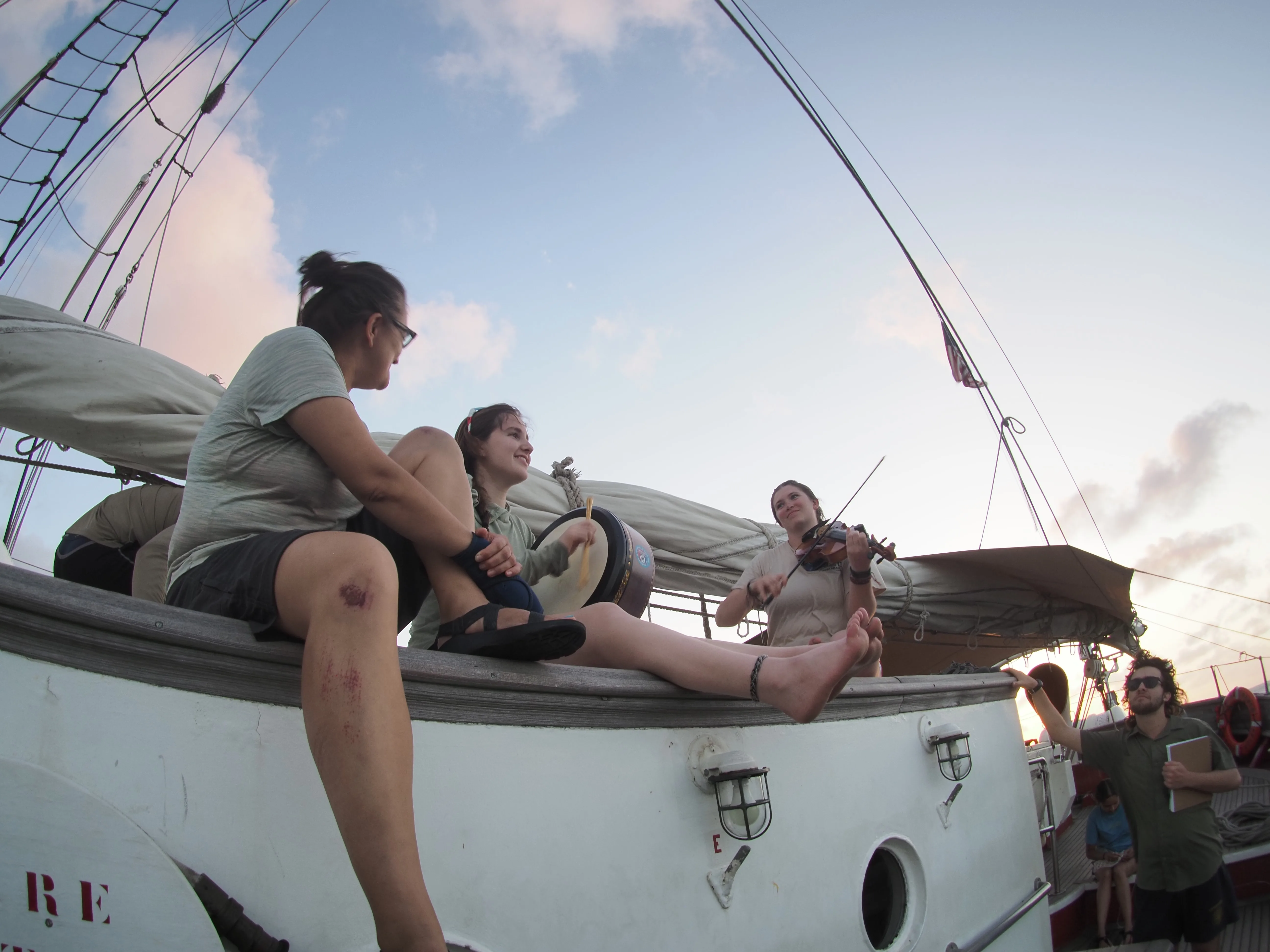
Music making at sea (Annie, me, Zara, and Everett pictured from left to right)
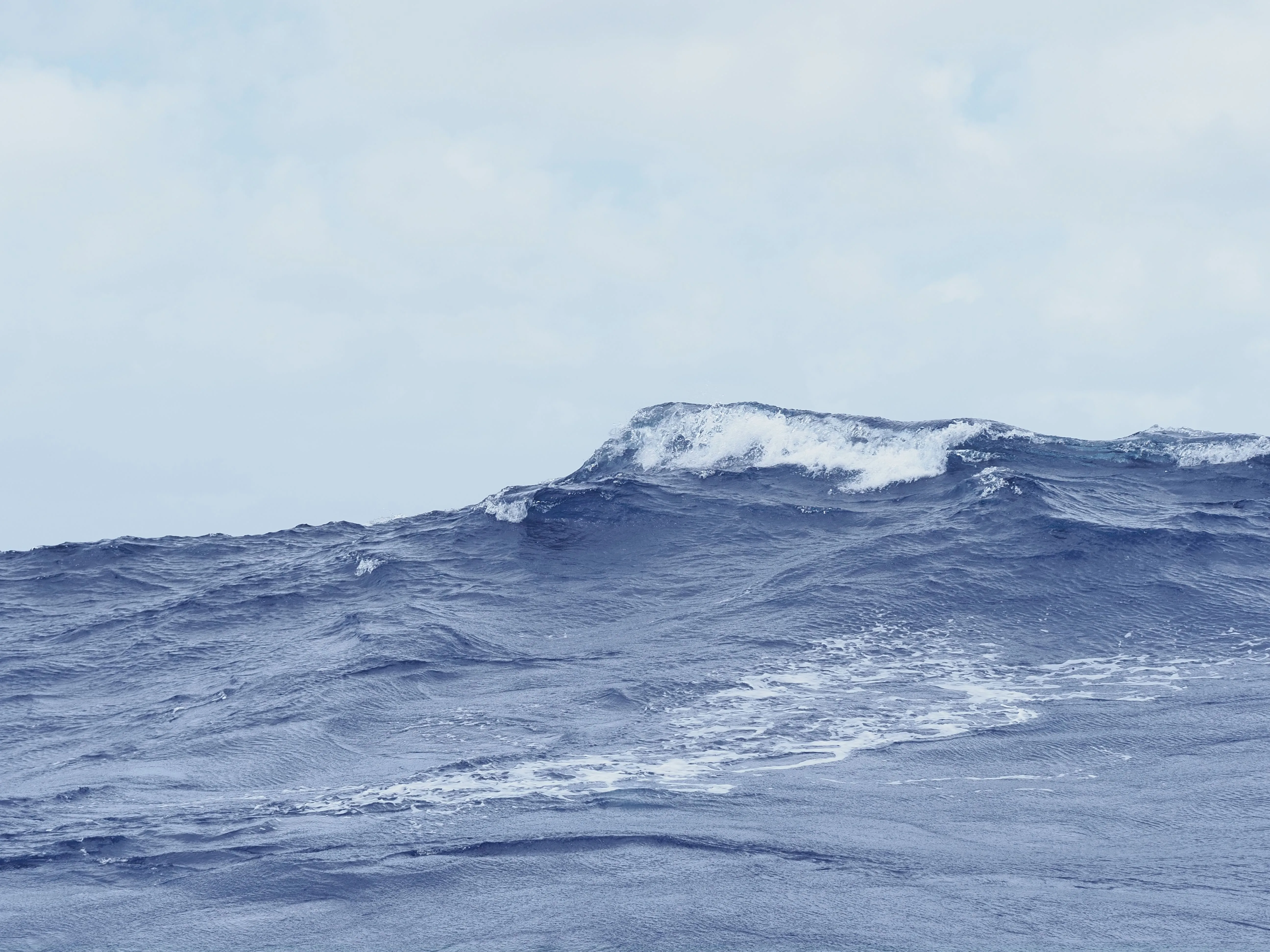
Big swell (optimal flying fish conditions)
Recent Posts from the Ships
- Ocean Classroom 2024-A collaborative high school program with Proctor Academy
- Collaborations and Long-term Commitments: SEA’s Caribbean Reef Program Sets a Course for Coastal Programs that Compliment Shipboard Experiences.
- Sea Education Association students prepare for life underway using state of the art nautical simulation from Wartsila Corporation.
- SEA Writer 2022, Magazines From the Summer SEA Quest Students
- Technology@SEA: Upgrades Allow Insight into Ocean Depths
Programs
- Gap Year
- Ocean Exploration
- High School
- Science at SEA
- SEA Expedition
- SEAScape
- Pre-College
- Proctor Ocean Classroom
- Protecting the Phoenix Islands
- SPICE
- Stanford@SEA
- Undergraduate
- Climate and Society
- Climate Change and Coastal Resilience
- Coral Reef Conservation
- Marine Biodiversity and Conservation
- MBL
- Ocean Exploration: Plastics
- Ocean Policy: Marine Protected Areas
- Oceans and Climate
- Pacific Reef Expedition
- Plastics and Biodiversity in the Sargasso Sea
- The Global Ocean: Hawai'i
- The Global Ocean: New Zealand
- The History of Whaling & Whale Conservation