
Programs Blog
St Croix: Learning how to Improve Local Conditions to Build Coral Resilience
Sunday, 1 March 2026
Noon Position: 16 ° 47.3’N x 063 ° 16.8’ W
Ships heading: 160 °
Ship speed: 5.20 knots
Log: 314.1 nm
Weather: 26.5 °C with light wind and the sun shining down
Location: Southwest of Nevis
Hello from the middle of the Caribbean Sea! After spending a week in St. Croix, we are currently on our way to Dominica. St. Croix was an amazing time!
While we were still on shore in Woods Hole, we researched St. Croix and the current local issues that are affecting coral reefs surrounding the island, so that as researchers, we have a better understanding of what kind of issues we are hoping to solve.
St Croix is the largest of the three U.S. Virgin Islands here in the Caribbean. That being said, it is only about 84 sq miles with two major towns: Christiansted and Frederiksted. Here, English is the primary language and the island has a population of ~56,200 people. St Croix is a beautiful island with a tropical to semi-arid climate, including very hot weather and a common easterly trade wind that you can almost always feel. While packing, we made sure to bring light and airy clothes, and also sun shirts for protection against the constant sun beating down. We will miss hurricane season, which runs from September to November most years.
Let’s talk about the elephant in the room though, the coral reefs. St. Croix is surrounded by vibrant reefs, particularly focused around the east end of the island. These reefs are high in biodiversity and provide vital ecosystem services to humans. For example, they support tourism and commercial and recreational fishing, which has an estimated economic value of $187 million annually. The reefs also protect the coast from severe storms by dissipating wave energy.
Throughout history, there has been a dramatic decline in Caribbean coral reefs. For our project, we are specifically focused on the local impacts on reefs, issues that originate from the island itself or local weather conditions. While on shore, we found that sediment runoff and overfishing were the most pressing local causes of reef damage. Runoff from agriculture, development, and unpaved roads drain into the sea. Corals have a high sensitivity to sediment runoff, as increased turbidity limits their access to sunlight and causes corals to expend energy for mucus production to expel sediment from themselves. There is also a high fishing pressure in St. Croix, especially the fishing of larger apex piscivores (fish that eat fish) and herbivorous fish that are important consumers of the turf algae that can take over reefs.
We took what we learned on shore and talked to local experts and citizens on St. Croix about the coral reefs, their conditions, and what can be done to help them thrive.
We enjoyed talking to many people like Kelcie Troutman from the East End Marine Park (EEMP) here on St. Croix. She shared her knowledge on overfishing and sedimentation, and what the island is doing to mitigate these issues. St. Croix has added Marine Protected Areas (MPAs) on the east side of the island to try and conserve fish species as well as limit infrastructure. Troutman explained to us that fish species like parrotfish, which were once everywhere, are becoming increasingly rare due to overfishing. Without these parrotfish who feed on algae, the algae grow and grow and start to take over reefs. Troutman continues to see at her job with the EEMP how fish decline is changing the reef ecosystem from coral dominate to algae dominate. She also expressed concerns about the island’s watersheds. At the EEMP, we saw maps of the islands “guts” which are temporary rivers that are engraved into the land, where rainwater flows into and then spills out into the oceans surrounding St. Croix. To try and prevent sediment in runoff water from getting into the oceans, St. Croix is trying to fix unpaved roads and plant mangroves to try and redirect and use this runoff water before it effects the reefs.
Besides these solutions, everyone we talked to including Troutman from the EEMP emphasized the need for education on the island. Many fishermen are not educated on the certain types of fish that are regulated, which causes even the critically endangered ones to still be caught. Troutman is working towards fishermen education so that endangered fish stay in the waters and not on someone’s dinner plate. The EEMP as well as The Nature Conservancy and Thriving Islands are pushing to teach children more and more about how one’s actions can change the ecosystems around them, as well as getting young children into marine biology so that they too can help in coral reef conservation efforts.
The most suprising thing we learned about while in St. Croix was about the island’s oil refinery. While driving from the airport to where our boat, the SSV Corwith Cramer, was patiently waiting for us, we drove by this huge infrastructure and both of us were surprised by its sight. In addition to briefly learning about it on the car ride to the ship, we heard a lot about it from the people on the island. This oil refinery used to be running and then shut down in 2012. Since then, different people have tried to get it back up and running, since it produced many jobs and promoted the island’s energy independence, but the environmental impacts have been too large. It has contaminated drinking water and oil has leaked into the ground. All of which are terrible for the whole ecosystem and humans, not just the coral reefs. That being said though, there is not much movement currently on what to do with the refinery and infrastructure.
Lastly, colonization has left a lasting mark on St. Croix. At The Nature Conservancy, we learned about how during this period of time, the Europeans made the enslaved people go out into the sea and harvest vast amounts of coral. These corals were used to be the building blocks to many buildings, monuments, you name it. Even walking around Frederiksted, you can see old coral skeletons from so long ago. This was crazy to learn about and once you learned about it, we could not stop looking at old buildings and seeing the sheer number of corals that were harvested. So, while there can’t be much done about this now, these corals were a reminder about the history of St. Croix and made us think about how we can build coral reefs around St. Croix back to levels that they were like before colonization.
It was great exploring and learning more about St. Croix through talking to citizens and researchers, and hearing their valuable stories. We can’t wait for the next adventures that we are sailing to!
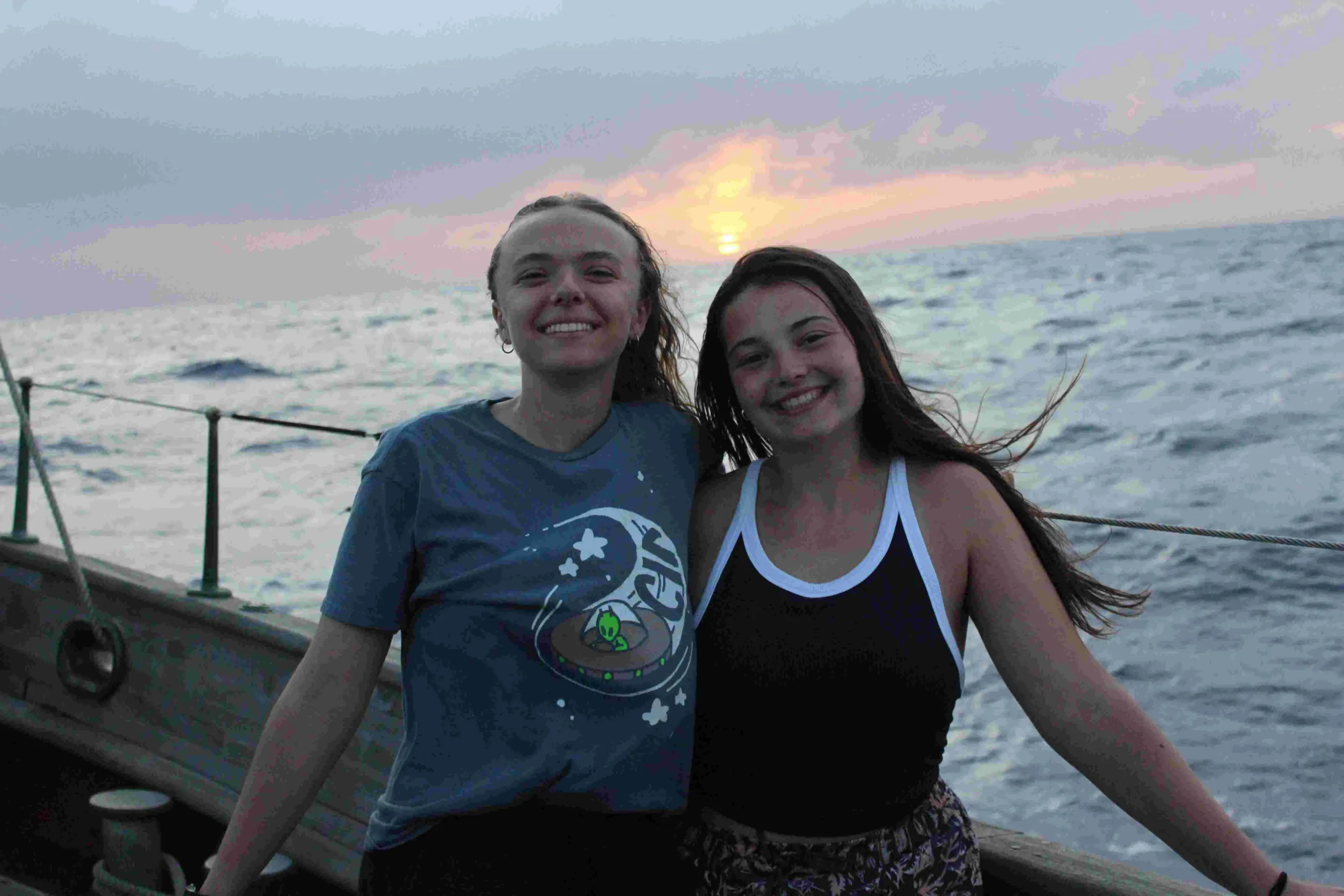
Emma Acri, A Watch, Cornell Univeristy & Riley Carver-Longley, C Watch, Oberlin College
Shout Outs:
Emma: Happy birthday Dad! Sending love to Mom, Dad, Tommy, Mimi, all of my Cornell friends, Megi, Alyssa, and even Lily and Tilly. Love all of you! I have seen so many flying fish and birds!
Riley: Giving hugs to Mommy, Mama, Grandpa, Caden, and Sabrina, I miss you! Sending love to everyone at Oberlin and beyond. The sea sickness hasn’t taken me out yet 🙂
Recent Posts from the Ships
- Ocean Classroom 2024-A collaborative high school program with Proctor Academy
- Collaborations and Long-term Commitments: SEA’s Caribbean Reef Program Sets a Course for Coastal Programs that Compliment Shipboard Experiences.
- Sea Education Association students prepare for life underway using state of the art nautical simulation from Wartsila Corporation.
- SEA Writer 2022, Magazines From the Summer SEA Quest Students
- Technology@SEA: Upgrades Allow Insight into Ocean Depths
Programs
- Gap Year
- Ocean Exploration
- High School
- Science at SEA
- SEA Expedition
- SEAScape
- Pre-College
- Proctor Ocean Classroom
- Protecting the Phoenix Islands
- SPICE
- Stanford@SEA
- Undergraduate
- Climate and Society
- Climate Change and Coastal Resilience
- Coral Reef Conservation
- Marine Biodiversity and Conservation
- MBL
- Ocean Exploration: Plastics
- Ocean Policy: Marine Protected Areas
- Oceans and Climate
- Pacific Reef Expedition
- The Global Ocean: Hawai'i
- The Global Ocean: New Zealand