
Programs Blog
The Island of Dominica
Dominica, known as the “Caribbean nature island”, is visually striking from our anchorage in Prince Rupert Bay – vibrant green plants and trees cover the mountainous land outside of the cities and towns dotting the western coastline we’ve traversed. Many of the pamphlets and books in the ship’s library concerning Dominica focus on its extensive flora and fauna, describing some species as endemic only to the island.
During our shore field trips in Dominica, we had the opportunity to learn from several local partners who are working to increase the resilience of coral reef ecosystems in Dominica, as well as infrastructural and social resilience on land. The Kalinago people, whose ancestral connection to the island predates Western colonialism, welcomed us into their territory and their homes.
Andrew Tyson, a farmer growing tomatoes, cucumbers, cassava, and plantains along a steep embankment, described some of his sustainable farming practices and emphasized their uneasy relationship to imported foods and the changing agricultural landscape in Dominica in the post-colonial era. He received a grant from the Dominican government for his farm that has helped build new infrastructure, but he also noted that many farmers in the Territory have abandoned their livelihoods for other work because farming has become so expensive and remains labor-intensive despite some increase in efficiency. He emphasized his desire to grow food for himself and his family without negatively impacting the terrestrial and marine ecosystems in Dominica.
Though they may seem unrelated to marine ecosystems, these practices are vital to nearshore coral reefs. During our time in the Caribbean, we have repeatedly heard the phrase “ridge to reef”: the idea that what happens on the islands’ highest peaks have direct impacts on the health and stability of reefs. Pesticides and fertilizers flow from the farm down the hills and valleys and into the ocean. In Dominica, where rainfall is a daily occurrence, these chemicals hardly have time to leech into the soil before they are washed away and carried down to the sea. The Kalinago people are committed to reducing the use of these harmful chemicals as much as possible both within their territory and outside of it.
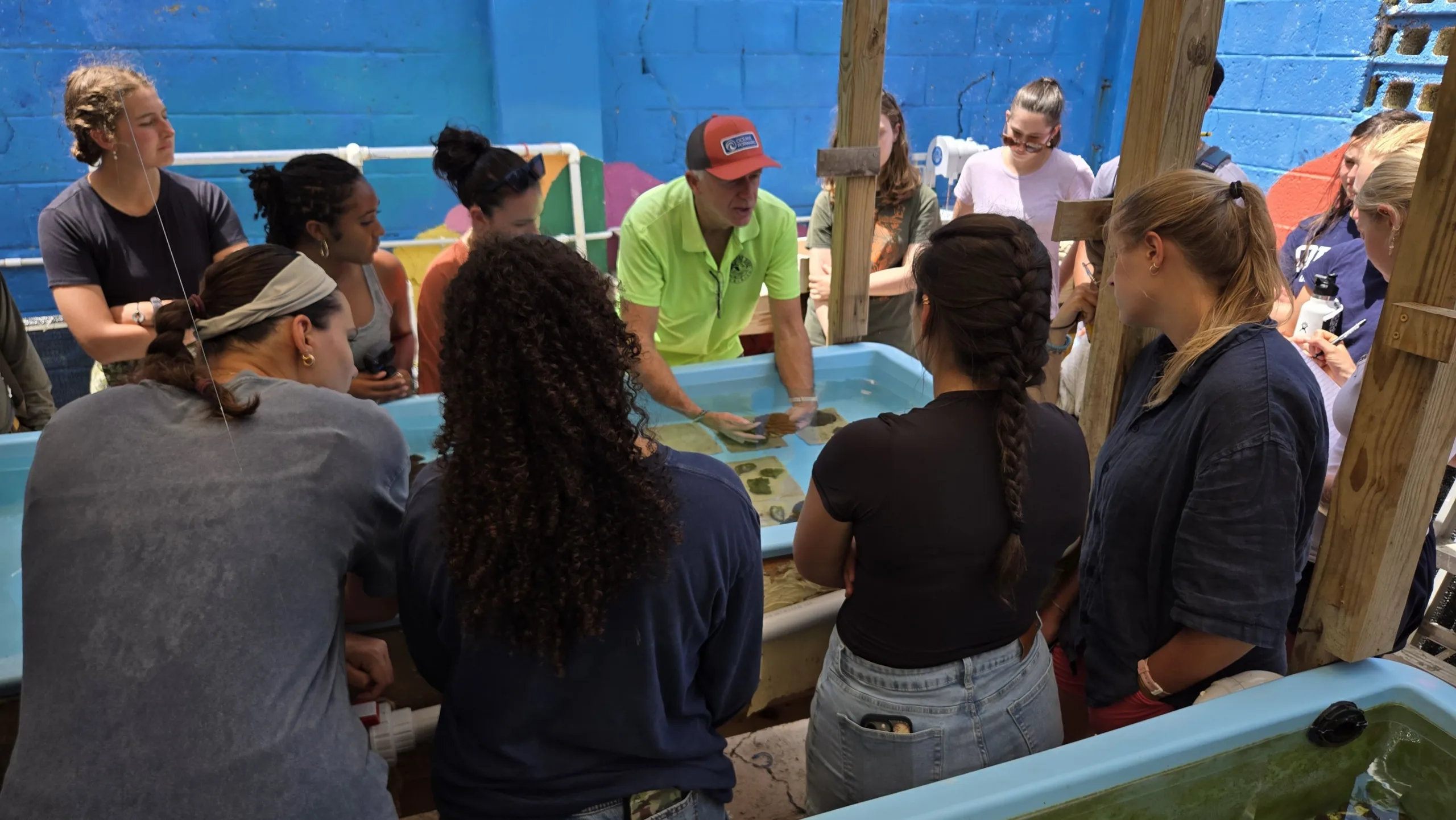
We were also lucky enough to be invited to Nature Island Dive’s coral restoration project in Soufriere Bay, led by Simon Walsh and Joseph Hillman. There, we learned about their work to prevent the spread of Stony Coral Tissue Loss Disease, which arrived on Dominica’s reefs in 2023. Despite their efforts, SCTLD wiped out 98% of the island’s maze coral. These days, their divemasters carry amoxicillin-imbued epoxy which, when packed around an infected site on a coral, serves as a boundary to prevent the spread of the disease.
Beyond working to prevent the spread of SCTLD, Nature Island Dive also has a coral fragmentation and preservation center. They utilize a strategy known as biobanking, which involves saving genetic stock for future coral growth. They ‘rescue’ detached coral fragments and bring them to their coral tanks, where they are further fragmented and grown under the careful supervision of their aquarist, Kiki. Corals take a long time to grow, and this process can be artificially sped up by growing fragments, so they converge together into one larger coral. This allows the coral to reach sexual maturity at a much faster rate, providing more opportunities for coral spawning and new genetic combinations on the reef.
Genetic diversity is one of the biggest problems facing coral restoration projects today. Corals reproduce both sexually and asexually, and convincing coral larvae to settle in captivity is a hurdle that science has yet to clear. Nature Island Dive gets around this problem by releasing the larvae back onto the reef. Their project has been successful so far both in terms of larval release and sexually mature coral out-planting. Simon emphasized that in the eyes of a dive customer, corals are not what makes a beautiful reef, but rather the biodiversity of fish and other marine animals. Yet corals are the main source of shelter and food, directly or indirectly, for most creatures living on the reef. Simon, Joe, and Kiki are working against the odds, but they all feel compelled to try whatever they can to increase the resilience of their local reefs.
From all the people we spoke with, a key takeaway is that human interference is the main driver of these changes in Dominican reef ecosystems. Overfishing, runoff of chemicals and excess nutrients, sea temperature rise, and coastal development are all stressors effecting marine ecosystems.
Shifting Baseline Syndrome describes the phenomenon that in periods of rapid change, each generation has a different idea of what ‘normal’ looks like. For example, people may think that the state of the reefs isn’t ‘bad’ compared to what they were like 20 years ago when they were growing up, yet they don’t realize that this “remebered” original state was already much lower than it was 50-75 years ago when the corals were thriving in these areas. We are continuing to see staggering losses of these reef ecosystems. Everyone we have learned from in the coral restoration world has to make active decisions to continue their work despite daunting odds and frequent setbacks. As Simon from Nature Island Dive reflected, “it’s an uphill battle, but I cannot do nothing.”
Maya Zoia, C-Watch, Cornell University; Eli Bundy, C-Watch, Bowdoin College, Daphne Altstadt, B-Watch, Louisville, KY
Recent Posts from the Ships
- Ocean Classroom 2024-A collaborative high school program with Proctor Academy
- Collaborations and Long-term Commitments: SEA’s Caribbean Reef Program Sets a Course for Coastal Programs that Compliment Shipboard Experiences.
- Sea Education Association students prepare for life underway using state of the art nautical simulation from Wartsila Corporation.
- SEA Writer 2022, Magazines From the Summer SEA Quest Students
- Technology@SEA: Upgrades Allow Insight into Ocean Depths
Programs
- Gap Year
- Ocean Exploration
- High School
- Science at SEA
- SEA Expedition
- SEAScape
- Pre-College
- Proctor Ocean Classroom
- Protecting the Phoenix Islands
- SPICE
- Stanford@SEA
- Undergraduate
- Climate and Society
- Climate Change and Coastal Resilience
- Coral Reef Conservation
- Marine Biodiversity and Conservation
- MBL
- Ocean Exploration: Plastics
- Ocean Policy: Marine Protected Areas
- Oceans and Climate
- Pacific Reef Expedition
- The Global Ocean: Hawai'i
- The Global Ocean: New Zealand