
Programs Blog
Thoughts on Evening Watch
Thursday, 07 May, 2026.
Noon Position: (Lat and Long): 33 degrees 25.1’ N, 068 degrees 28.0’ W
Log (nm): 2399 nm
Weather / Wind / Sail Plan (from 1300 Watch Change): Wind building to a Beaufort Force 5, sailing under the four lowers
Description of location: North Sargasso Sea
A day on the Corwith Cramer lasts 72 hours. That’s how long it takes to stand a full cycle of afternoon, morning, dawn, and evening watch—six hours on duty and twelve hours stood down, four times.
It’s been two boat days since the watches rotated to stand with different staff members. I have now gotten the chance to stand multiple watches with every student on board. And I’ve found, to my surprise, that the students have made evening watch my favorite watch.
This is unlikely because by many people’s reports, evening watch can suck tremendous. It is, after all, Galley Cleanup watch, nightly host of the Galley Mat Gauntlet, and it’s the watch of working until 1am after staying up until 7am the previous day. I usually amp myself up on coffee to bang out dishes and do battle with a trash compacter that demands the precise firmness one normally reserves for pulling swords out of stones.
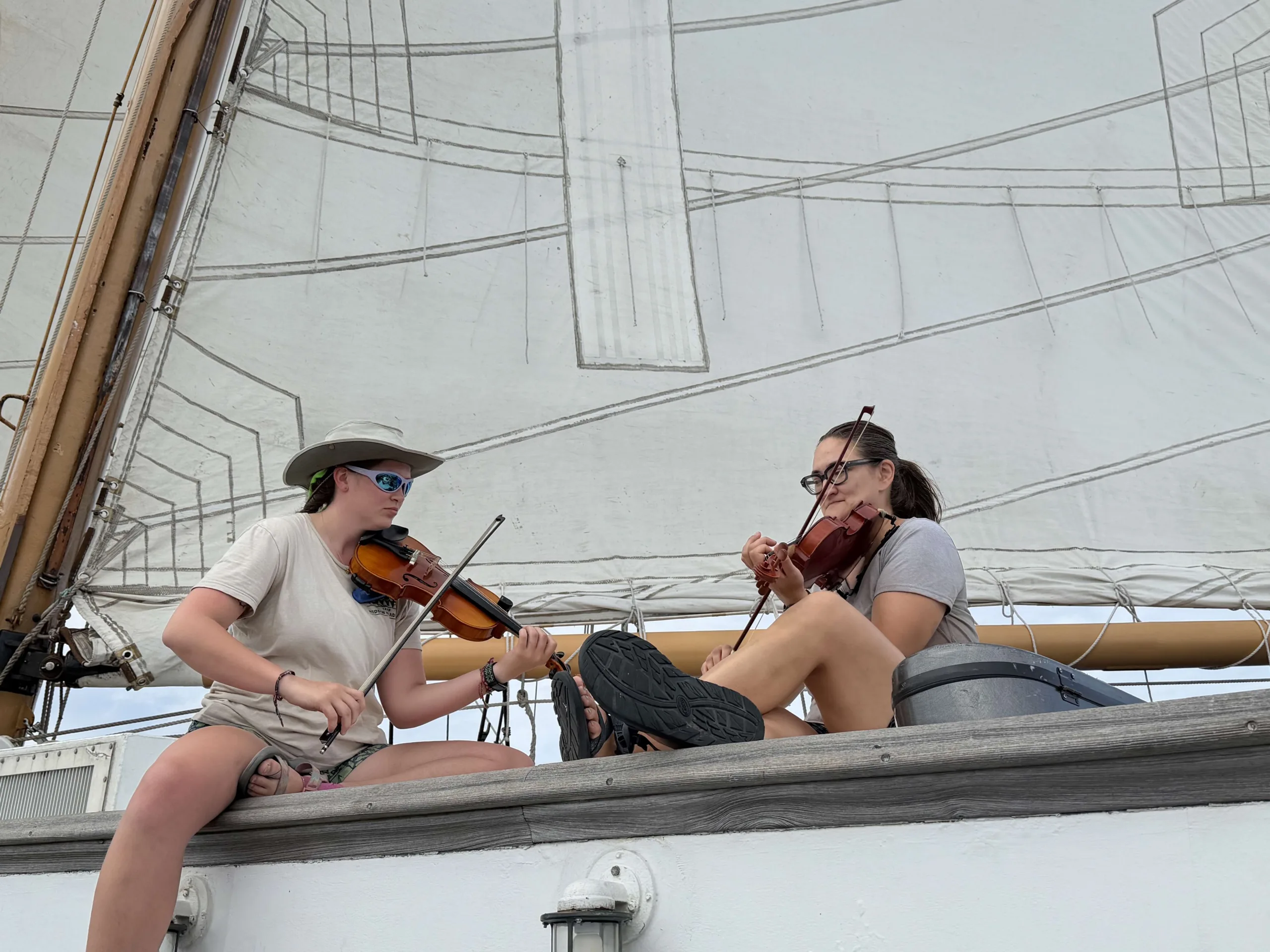
Nevertheless, I await evening watch eagerly all boat-day long. Some students like to sing during galley cleanup—I got to join B watch in a rousing chorus of “Country Roads” one evening—but that isn’t why it’s my favorite watch. After all, the students have frequent jam sessions when they aren’t on watch, and I can hear singing from the forward lookout most hours of the day.
Evening watch in lab usually also means prepping samples for DNA extraction. We get to work with little frozen tubes filled with, variously: myctophids (lanternfish); siphonophores; zooplankton; and the invisible film of biology that our fellow scientists collected from microplastics earlier in the day. But that also isn’t why evening watch has become my favorite. We do molecular procedures throughout the day, and the dawn watch routine often involves more pipetting into more little tubes. (Nothing makes a person feel more like a scientist than accurately pipetting into a tiny tube while the lab swings and yaws all around).
No, my favorite part of the boat day is the evening watch deployment. It’s usually a Neuston net, which we drag from a long metal pole through the surface, or Neuston layer, of the ocean, collecting anything larger than 333 micrometers. Each watch has now gotten to do a meter net, as well, which has the same size mesh but travels on a thick wire from the surface down to a depth of about 150 meters.
When the moon is full, we deploy our gear under a bright sky, no headlamps required. It’s easy to see the Neuston net float through the water and the meter net descend. But we can’t see what’s going into them. The nets, which have wide metal frames (mouths) and long, tapering mesh bodies (ending in “cod end” jars), pick up everything from microscopic copepods to big clumps of sargassum.
On other nights—around the new moon, or when the moon rises after midnight—we track a net by looking at the glowing outline of bioluminescent organisms that bump up against its frame and mesh. It looks ghostly, and the cod end jar looks like it’s filling up with little green stars.
The students speculate about what they might pull up the net. “I wonder if we’ll finally catch a physalia!” “Or some velella!” “I heard they got, like, twelve myctophids the other night!” “Look—look what’s going in there now, it’s huge, it’s round, it’s so glowy!”
And I can hear them getting familiar with the mechanics of deployment, too. “Look at how the glow fades in and out: I think that means Neusty is sitting too low in the water. Can we get deck to speed up a little?” “The cod end is floating—we must have gotten a ton of sargassum this time.”
When they finally get the net back to deck, the students race to pour out the contents of the cod end jar, releasing a glittery swirl of critters into a waiting bucket. Some people like to stare into the bucket in the dark, turning it occasionally to trigger more luminescence. Others race to examine the bucket under the lab lights. Nobody can contain their excitement. They call out to their watchmates on the quarterdeck, the ones responsible for sailing operations, and tell them to come see.
We send out a net every evening watch. It never gets old.
We did, indeed, finally catch a physalia (Portuguese man-o-war) during a Neuston tow the other night. Natalie Ng was the Junior Lab Officer who processed it, lifting up its taut white-blue float from the bucket so that we could see its long purple tentacles, which are crinkled like yarn from an unraveled sweater. (Sailors who’ve caught physalia in dip nets include Cami Nakagawa, Simon Braun, Etta Lund, and Sam Ruemmler.) We’ve gotten many velella (by-the-wind-sailors), too, which sit on top of the water on indigo floats, and dozens of myctophids. Aiden Houlihan, our fish identification expert, says myctophids have soulful eyes. I think they always look like they’re having a slightly worse day than you.
We can’t identify the zooplankton we capture until we put them under a microscope, but they can be just as charismatic as the big guys once you zoom in. Vivid blue copepods, intricate little pteropod snails, golden sargassum nudibranchs—everyone on board has one that makes them stop and marvel, no matter how tired they are.
This is the best part of my job. It’s the reason evening watch has become my favorite. Every boat night, I get to watch the ocean open itself up to the students, one net, one bucket, one shimmering creature at a time.
Annie Osborn, 3rd Marine Tech, C Watch
P.S. Happy birthday to my beloved goddaughter to my wonderful father!
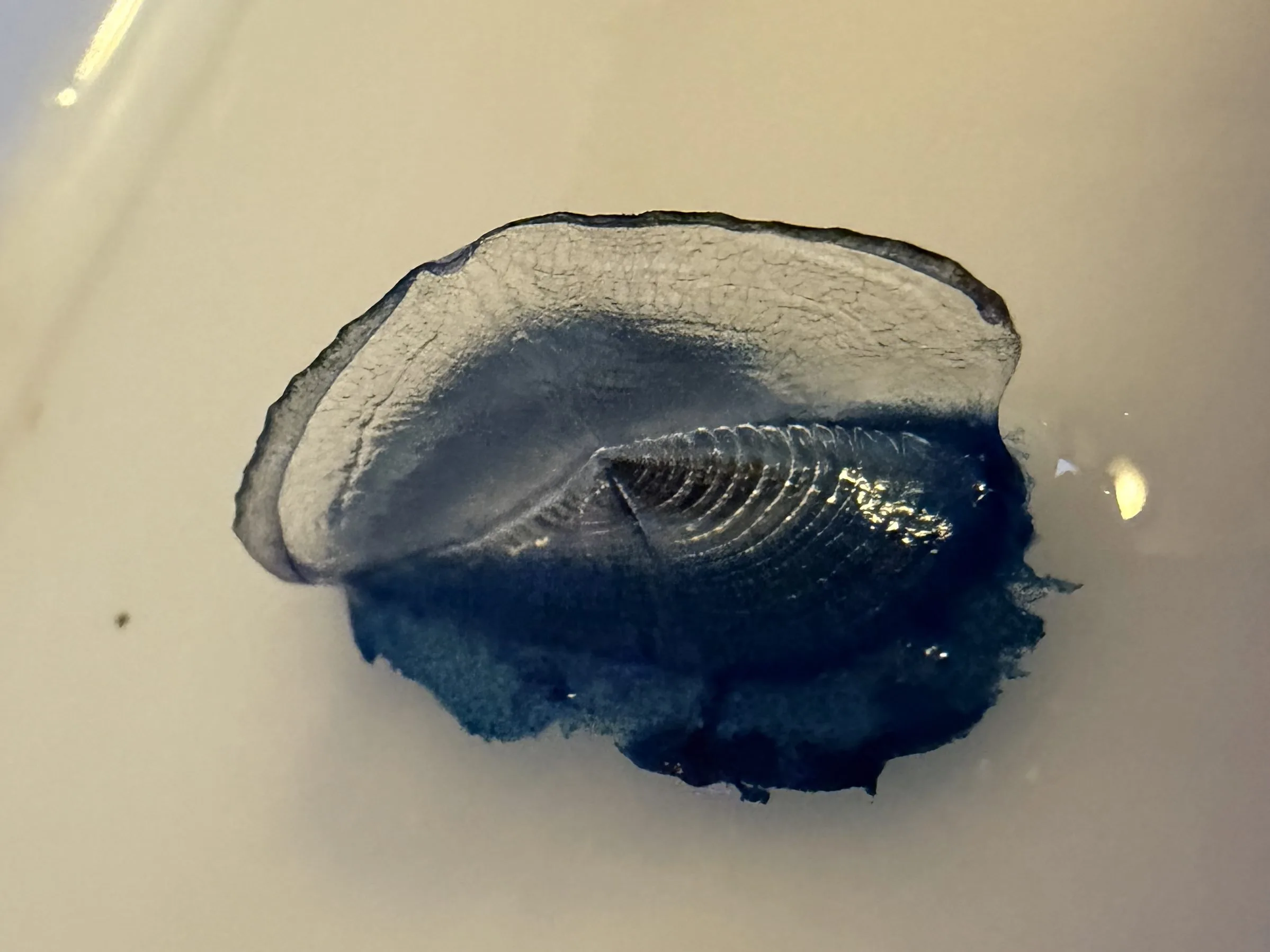
Velella velella
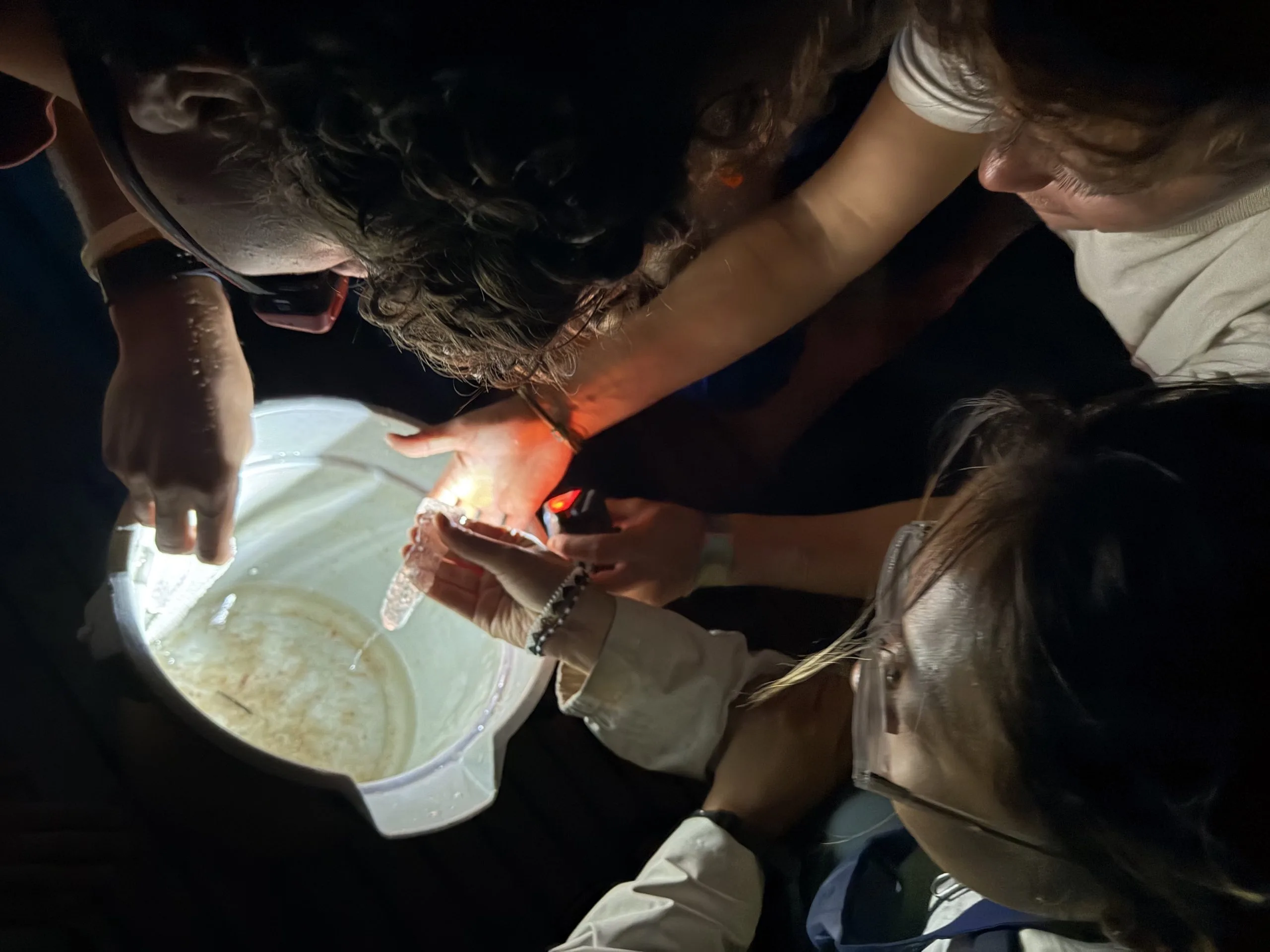
Simon Braun (C Watch), Süpi Valles (molecular tech), and Natalie Ng (C Watch) admire a pyrosome caught during a meter net deployment.
Recent Posts from the Ships
- Ocean Classroom 2024-A collaborative high school program with Proctor Academy
- Collaborations and Long-term Commitments: SEA’s Caribbean Reef Program Sets a Course for Coastal Programs that Compliment Shipboard Experiences.
- Sea Education Association students prepare for life underway using state of the art nautical simulation from Wartsila Corporation.
- SEA Writer 2022, Magazines From the Summer SEA Quest Students
- Technology@SEA: Upgrades Allow Insight into Ocean Depths
Programs
- Gap Year
- Ocean Exploration
- High School
- Science at SEA
- SEA Expedition
- SEAScape
- Pre-College
- Proctor Ocean Classroom
- Protecting the Phoenix Islands
- SPICE
- Stanford@SEA
- Undergraduate
- Climate and Society
- Climate Change and Coastal Resilience
- Coral Reef Conservation
- Marine Biodiversity and Conservation
- MBL
- Ocean Exploration: Plastics
- Ocean Policy: Marine Protected Areas
- Oceans and Climate
- Pacific Reef Expedition
- Plastics and Biodiversity in the Sargasso Sea
- The Global Ocean: Hawai'i
- The Global Ocean: New Zealand
- The History of Whaling & Whale Conservation