
Programs Blog
Navigation as of late (puzzle included)
Sunday, 19 April, 2026.
Noon Position: (Lat and Long): 26 degrees 51.7’ N, 063 degrees 02.1’ W
Log (nm): 1049 nm
Weather / Wind / Sail Plan (from 1300 Watch Change): sailing under the four lowers with a shallow reefed mains’l, c/o 005º, wind is F4 ESE, making 4.5 knots
Description of location: S. Sargasso Sea
Greetings travelers, mariners, and those who are reading this from the comfort of their own homes,
It’s Zara, here to teach you the basics of navigation, mostly of the celestial variety:
Step 1: Find someone to teach you all about the stars, what they’re called, and which ones might be good or easy to shoot (thank you, Sam).
Step 2: Acquire a sextant. This one might be a bit tricky because I have a sneaking suspicion they are kind of expensive.
Step 3: Go to sea! This is probably not feasible for everyone reading this. Luckily, that’s where I am right now, so I’ve been practicing.
Step 4: Shoot the stars… if they’re visible (eek).
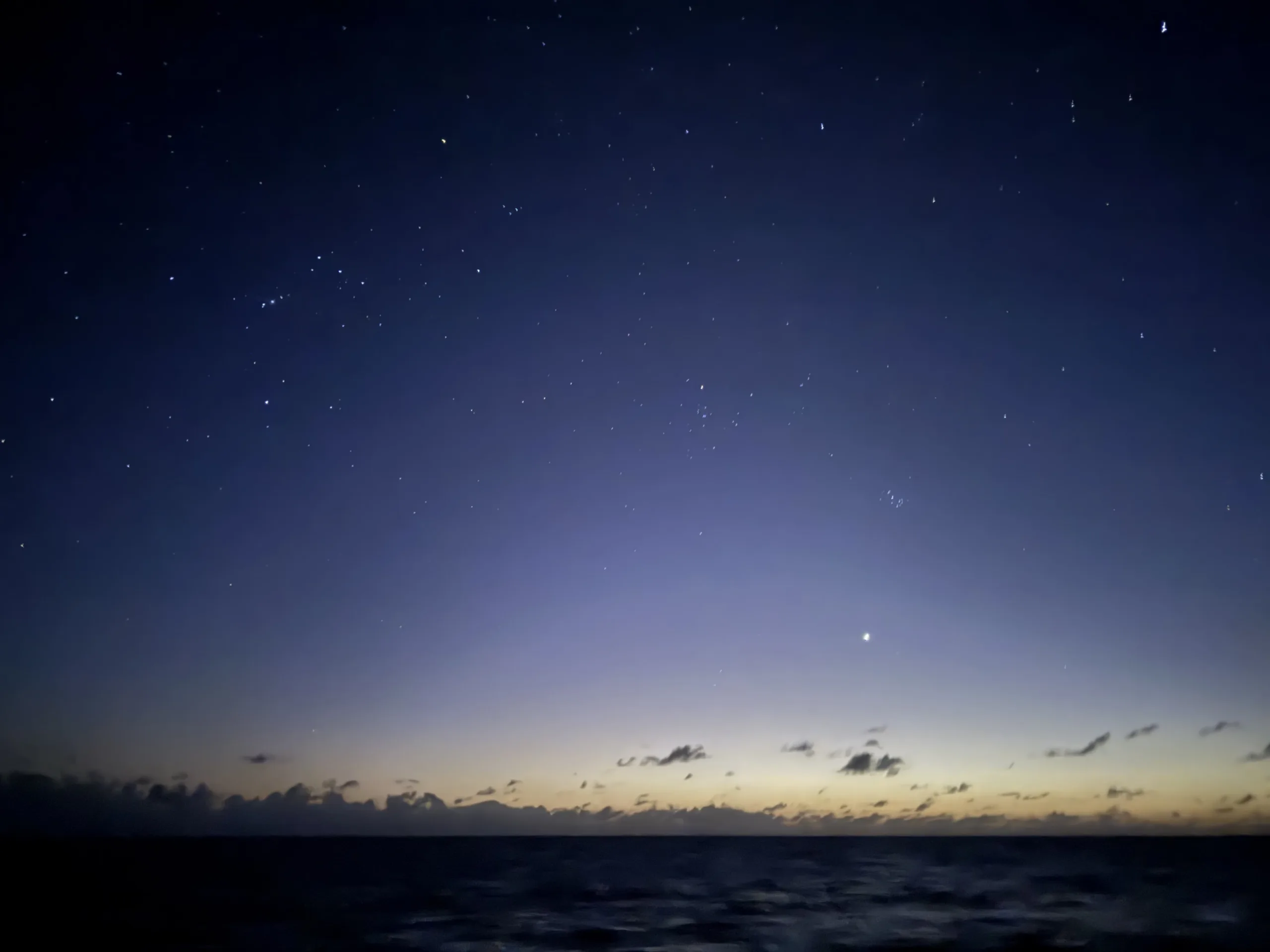
The stars are very beautiful out here in the middle of the ocean. They are usually quite visible— most nights you can follow constellations through the sky throughout your watch. A watch isn’t quite long enough to watch a constellation rise and set, but you can see things go about three-quarters of the way across the sky.
Last week, almost every night was clear. The only clouds were little puffs on the horizon. This week has been a bit of a different story. My last few watches have been plagued by squalls (that’s pretty typical for where we are are). However, squalls mean that you can’t see the stars during sunset and sunrise, the times when we can get a star fix. Because of this, we have been hoping our dead reckoning (DR) skills are good, because otherwise we have no idea where we are (kidding… we have GPS too).
The big idea behind celestial navigation is that we use it as a fix for DR. DR involves picking a direction and sailing that way over a certain amount of time or distance, but it doesn’t account for any of the drifting that we might be doing. Drifting can happen when your sails are not properly trimmed or if there is a current dragging you a different way from where you want to be going. Because DR becomes inaccurate over time, we can reset it by correcting our position with a fix. You can do a fix a couple different ways. You can use the GPS (which we try not to do), shoot a sun or moon line, or a do star fix.
A sun or moon line on its own can only determine a line of position— a line that you are on… somewhere— which is only very helpful when you have something to compare it to. However, there is a special sun fix you can do at local apparent noon that will give you your exact latitude. Otherwise, you need a previous fix that you can advance in order to use a sun or moon line to determine position.
You can use a star fix to determine your exact position because when the sun sets, there is generally more than one star out. The idea is similar to a sun line where you determine a line of position, but because you can shoot many stars (ideally, at least three), you can use the intersections of the lines to triangulate where exactly you are. However, star fixes only work if you know what stars you are looking at! Luckily, Sam (C watch deckhand extraordinaire) knows a lot about stars and has been teaching people what they are called and how to find them.
The first thing I learned is called the celestial G. It consists of a nine nav stars and six constellations and, coincidentally, looks like a big G, so it’s hopefully easy to see in the night sky. It starts in Orion, which I feel like most people can find. The top two stars (the hands?) are called Betelgeuse and Bellatrix, and the bottom-most star (a foot, probably) is called Rigel. Next is Sirius to the left. It’s the brightest star in the sky, which should make it easy to find. Sirius is part of Canis Major right next to Orion, because he doesn’t go anywhere without his dog. The next star, Procyon, is above Sirius in Canis Minor. I suppose Orion also has a little dog? After that is Pollux and Castor in Gemini. These are kind of tricky to find because they aren’t as bright as some of the other stars in the celestial G, but Jupiter is in Gemini right now, which makes the whole constellation easier to find. After that, we jump to Capella in Auriga. Auriga looks a big like a stretched-out pentagon, but I’m pretty sure it’s supposed to be a shepherd…? The last star in the celestial G is Aldebaran, which is also known at the eye of Taurus. Once you see it, it looks like Taurus is staring at you from the sky, which can be a tad bit disconcerting. Some other stars that are easy to see most of the time are Dubhe and Alkaid in the Big Dipper. Dubhe is the rim of the cup and Alkaid is the end of the handle. Both of them have been in the optimal star-shooting range recently, so I’ve gotten pretty familiar with them.
I’m excited to see where the cel nav train takes me! I’m looking forward to knowing more stars and constellations in life, but I will be a little bit sad when there is no horizon line. Because cel nav has to do with the height of the stars, the horizon is really important, which is why you can only really shoot stars at sunrise and sunset. Therefore, cel nav is very much a mariner’s tool. This makes it feel extra special when I shoot stars, because I know I will only be able to do it while at sea.
Zara Craig, C Watch
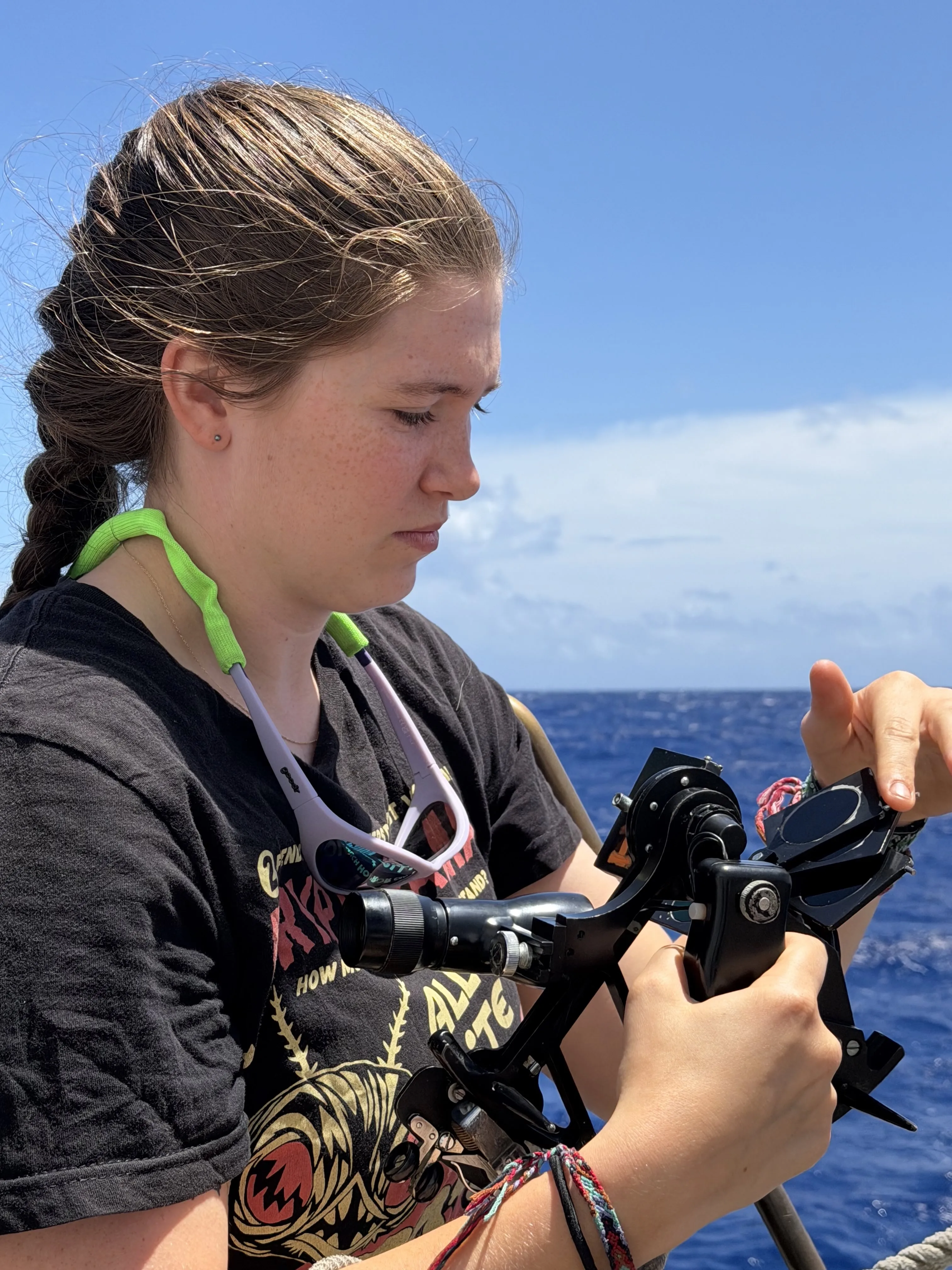
Selecting shades to shoot the sun (pc: Sarah K)
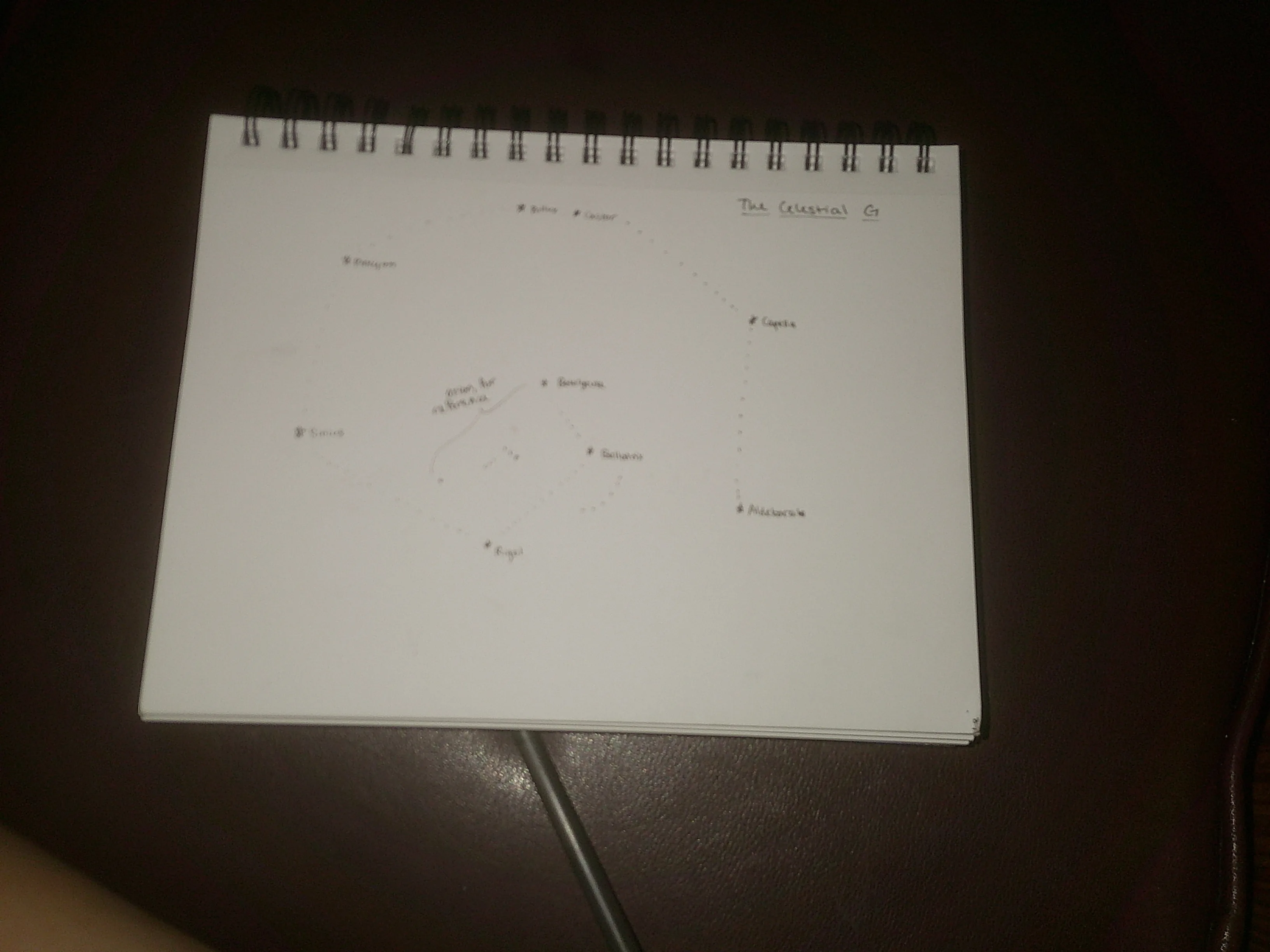
A pretty bad photo of an artistic representation of the celestial G by Zara (my camera apparently doesn’t take very hi-res photos after a certain hour… she’s tired!)
Recent Posts from the Ships
- Ocean Classroom 2024-A collaborative high school program with Proctor Academy
- Collaborations and Long-term Commitments: SEA’s Caribbean Reef Program Sets a Course for Coastal Programs that Compliment Shipboard Experiences.
- Sea Education Association students prepare for life underway using state of the art nautical simulation from Wartsila Corporation.
- SEA Writer 2022, Magazines From the Summer SEA Quest Students
- Technology@SEA: Upgrades Allow Insight into Ocean Depths
Programs
- Gap Year
- Ocean Exploration
- High School
- Science at SEA
- SEA Expedition
- SEAScape
- Pre-College
- Proctor Ocean Classroom
- Protecting the Phoenix Islands
- SPICE
- Stanford@SEA
- Undergraduate
- Climate and Society
- Climate Change and Coastal Resilience
- Coral Reef Conservation
- Marine Biodiversity and Conservation
- MBL
- Ocean Exploration: Plastics
- Ocean Policy: Marine Protected Areas
- Oceans and Climate
- Pacific Reef Expedition
- Plastics and Biodiversity in the Sargasso Sea
- The Global Ocean: Hawai'i
- The Global Ocean: New Zealand
- The History of Whaling & Whale Conservation