
Programs Blog
They put a Long Islander in the Galley
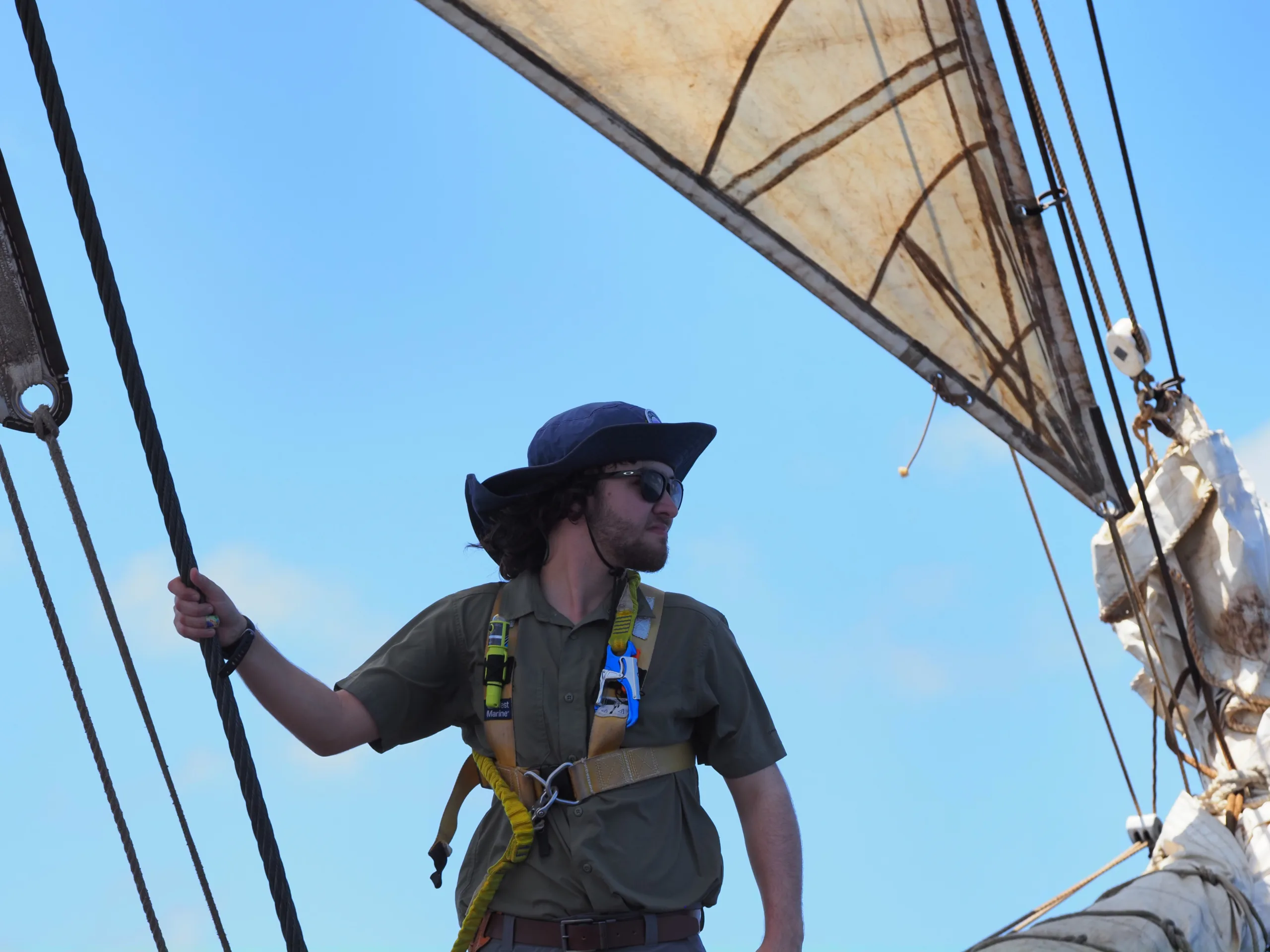
Monday, 20 April, 2026.
Noon Position: (Lat and Long): 27 degrees 53.4’ N, 064 degrees 31.2’ W
Log (nm): 1137 nm
Weather / Wind / Sail Plan (from 1300 Watch Change): Sailing c/o 330° PSC under four lowers with shallow-reefed mains’l. Wind SxW force four, distant squall off the port bow.
Description of location: Sargasso Sea, North Atlantic Subtropical Gyre, a few hundred nautical miles south of the Bermudan EEZ (exclusive economic zone)
Hello from your Seafaring Stumpy!
I am writing to you all hot off the tail of my day as Stu Stew- a student steward who helps our steward Shelby and assistant steward Sally around the galley, as well as planning a few of the meals or snacks for the day. It was an interesting change of pace from the typical deck/lab watch rotation, as I had plenty of time to sit up on the lab top and catch up on Braiding Sweetgrass while listening to Sophie, Annie and Tenny create wonderful music atop the charthouse. For morning snack, I made scones embedded with craisins and dried mango, an interesting combination that turned out delicious (I think you would enjoy it dad). For lunch, we made a classic: sausage and peppers. The piles of caramelized green peppers and onions suspending delicious Italian sausage were served up with dinner rolls, as hot dog buns are hard to come by in the Sargasso Sea. Lunch was delicious, a taste of home and a reminder of summer days outside. Shelby and Sally knocked it out of the park for dinner with a bibimbap featuring well-seasoned roast pork delicious quick pickled veggies, and fried eggs to top it off. For the prepared midnight rations, Sally masterfully handled my request for Earl Grey cookies. It was awesome to spend a day in the galley with Shelby and Sally, I learned a lot about what goes into cooking for 30+ people, plus I got a little better at breaking eggs, which I am sure my housemates (plus Emmy) will appreciate.
Moving on from galley adventures, I can welcome you all to week 3 of life here aboard the Cramer! We haven’t seen land in quite some time, a far cry from the dense wilderness of Cranberry Lake. The ocean likes to put on colors you never get to see within sight of land, but the clouds remind me largely of two places. When a squall rolls in and the sky fills with towering dark cumulus clouds, I am brought back to hiking through New Mexico during rainy season, albeit with a far more suitable set of four weather gear. On days of light rain, the sky takes on a form anyone who has spent time in Syracuse is all too familiar with.
By the end of this week of sailing, we will be nearing Bermuda. I am looking forward to standing watch again, especially lookout. Standing up at the bow of the Cramer gives you a nearly 360° view of the horizon, broken only by our two masts. While looking out for weather coming our way and any potential ship traffic, I often look for signs of wildlife as well. Flying fish have been seen off our bow almost every day since we started our journey, yet I still love watching them. When a school of them jumps from below the surface I find myself wondering about how evolution could have possibly led them down the path of adaptations that resulted in gliding above the swell. Aside from the fish below, I have been keeping a close eye on the occasional bird above, with highlights so far being sandwich terns, magnificent frigatebirds, brown boobys, masked boobys, band-rumped storm petrels, white-tailed tropicbirds, and some shearwaters farther out that I think are Cory’s shearwater. At night, the stars are numerous, and lookout by starlight is a far more meditative role than its daylight counterpart. As we continue to move northward, temperature slowly drops, which I appreciate. I am excited for the day I can change shorts and a short sleeve for a nice sweater and some pants.
As we take on more responsibility on the ship, the increased duties in lab interest me, especially the opportunity to learn how to ID samples from the family Myctophidae—the lanternfish— to species. Lab work on a boat requires more focus than on land, as the swell of the ocean mixed with a micropipette makes for quite the exciting combination when preparing DNA samples for long term storage.
My hair has also gotten quite long! Our Second Mate/Bosun Shel has helped me figure out how to get it pulled out of my face with a bandana, where I was missing one crucial step. I am excited to see just how long my hair will get by the time we return to Cape Cod, where a haircut will be necessary before the summer heat.
Sailing aboard the Cramer is a blast, and our data collection for our research project is off to a good start. Hello to Mom, Dad, Atticus, and Grandpa, I miss you guys! I can’t wait to show you the culmination of our hard work at the Symposium in May. I hope all is well, and I promise I am ok Mom. To my ESF friends: I hope your semesters are winding down smoothly, and I have been getting plenty of good ideas for the campaign, stay tuned.
For now, this is all from me! We have plenty more adventure ahead of us aboard the Corwith Cramer so stay tuned for more science and sailing!
Fair winds, following seas, and friendly trails,
Everett Gamache, A watch
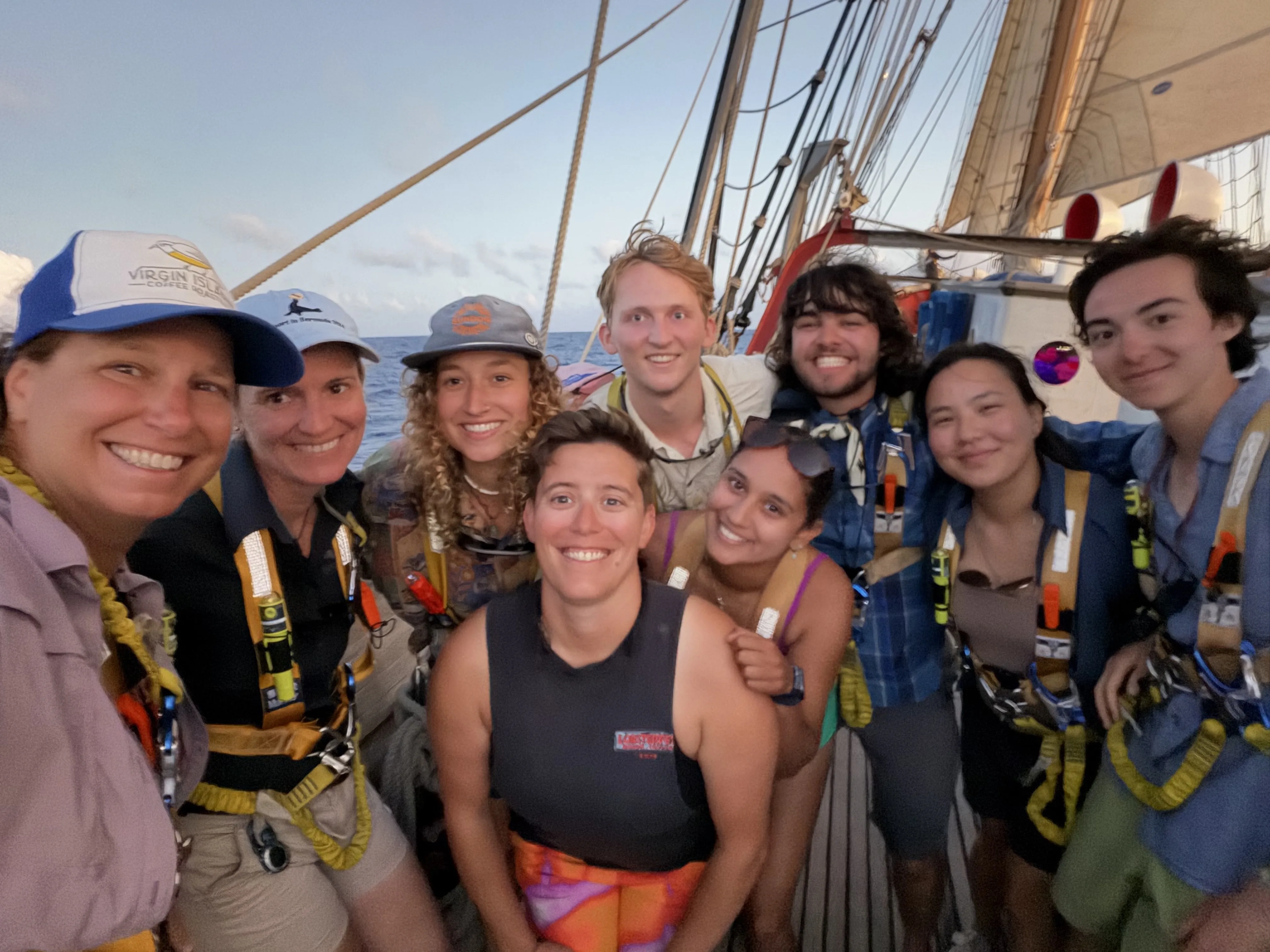
A Watch, plus some others! From left to right: Dr. Sarah Kingston, Captain Alison Taylor, Gray George, Supi Vallas, Tennyson Stinson, Keya Mookencherry, Everett Gamache, Cami Nakagawa, and Ciaran Gavaghan (photo by Dr. Sarah Kingston)
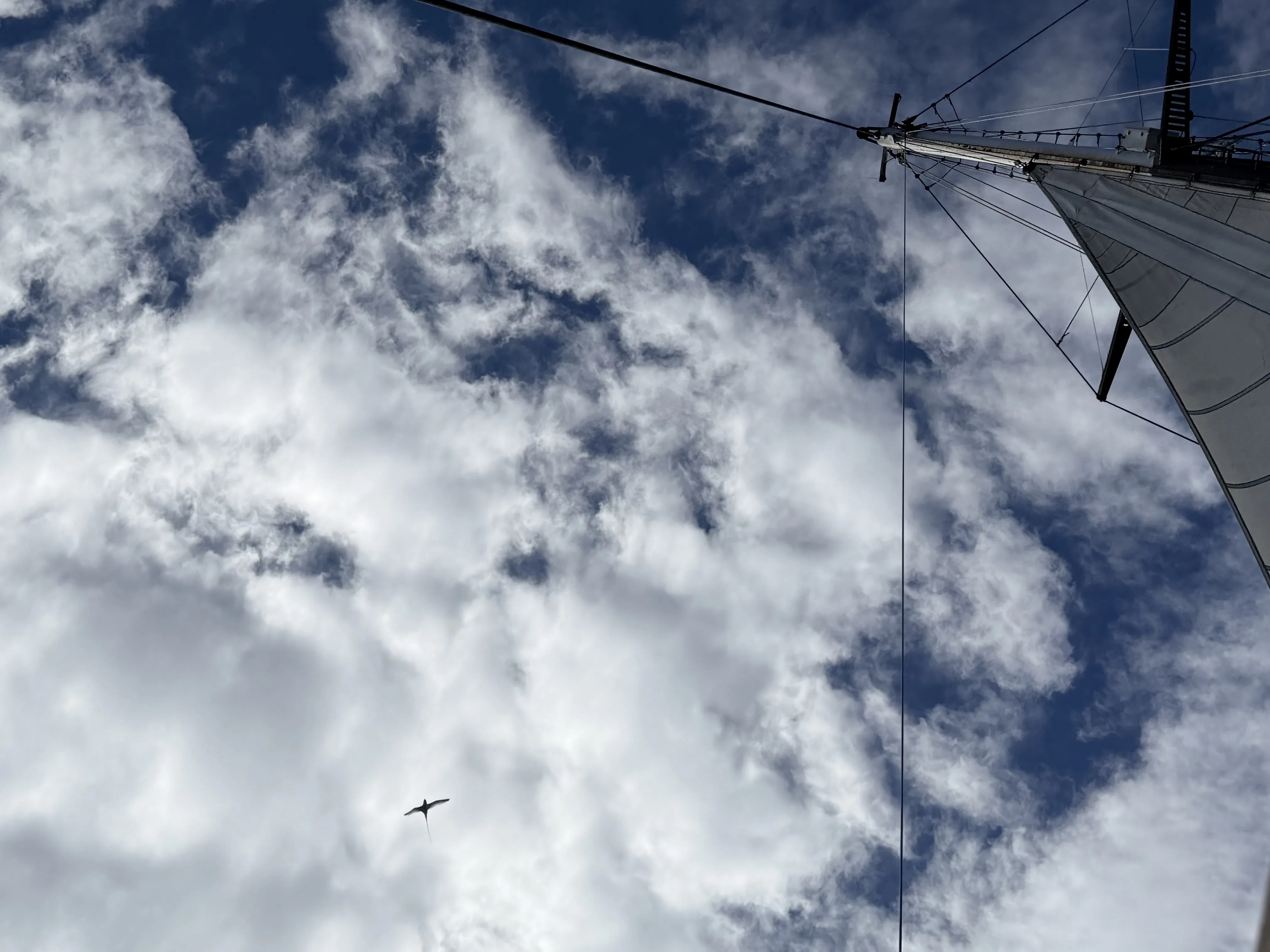
A tropicbird (likely a white-tailed tropicbird) flying above the Cramer near the mainmast (photo by Dr. Sarah Kingston)
Recent Posts from the Ships
- Ocean Classroom 2024-A collaborative high school program with Proctor Academy
- Collaborations and Long-term Commitments: SEA’s Caribbean Reef Program Sets a Course for Coastal Programs that Compliment Shipboard Experiences.
- Sea Education Association students prepare for life underway using state of the art nautical simulation from Wartsila Corporation.
- SEA Writer 2022, Magazines From the Summer SEA Quest Students
- Technology@SEA: Upgrades Allow Insight into Ocean Depths
Programs
- Gap Year
- Ocean Exploration
- High School
- Science at SEA
- SEA Expedition
- SEAScape
- Pre-College
- Proctor Ocean Classroom
- Protecting the Phoenix Islands
- SPICE
- Stanford@SEA
- Undergraduate
- Climate and Society
- Climate Change and Coastal Resilience
- Coral Reef Conservation
- Marine Biodiversity and Conservation
- MBL
- Ocean Exploration: Plastics
- Ocean Policy: Marine Protected Areas
- Oceans and Climate
- Pacific Reef Expedition
- Plastics and Biodiversity in the Sargasso Sea
- The Global Ocean: Hawai'i
- The Global Ocean: New Zealand
- The History of Whaling & Whale Conservation